One In Three Billion Found: Single Mutation In FOXL2 Gene May Cause Granulosa Cell Ovarian Cancer

“… Vancouver scientists from the Ovarian Cancer Research (OvCaRe) Program at BC Cancer Agency and Vancouver Coastal Health Research Institute have discovered that there appears to be a single spelling mistake in the genetic code of granulosa cell tumours, a rare and often untreatable form of ovarian cancer. This means that out of the three billion nucleotide pairs that make up the genetic code of the tumour, one – the same one in every tumour sample – is incorrect. The discovery, published online June 10th in the New England Journal of Medicine, marks the beginning of a new era of cancer genomics, where the complete genetic sequence of cancers can be unravelled and the mutations that cause them exposed. For women with granulosa cell tumours it represents the first specific diagnostic tool and clear path to develop much needed treatments for this cancer. …”

Found: One in Three Billion

The spelling mistake in the genetic code that causes a type of Ovarian Cancer

Eureka! Vancouver scientists from the Ovarian Cancer Research (OvCaRe) Program at BC Cancer Agency and Vancouver Coastal Health Research Institute have discovered that there appears to be a single spelling mistake in the genetic code of granulosa cell tumours, a rare and often untreatable form of ovarian cancer. This means that out of the three billion nucleotide pairs that make up the genetic code of the tumour, one – the same one in every tumour sample – is incorrect. The discovery, published online June 10th in the New England Journal of Medicine, marks the beginning of a new era of cancer genomics, where the complete genetic sequence of cancers can be unravelled and the mutations that cause them exposed. For women with granulosa cell tumours it represents the first specific diagnostic tool and clear path to develop much needed treatments for this cancer.

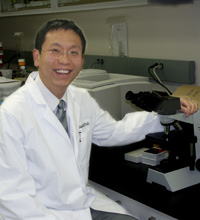
Dr. David Huntsman

David Huntsman, M.D. (Nfld.), Associate Professor, Department of Pathology & Laboratory Medicine, University of British Columbia; Genetic Pathologist, BC Cancer Agency

“This is really a two-fold discovery,” says Dr. David Huntsman, lead author and genetic pathologist at the BC Cancer Agency and Vancouver General Hospital and associate professor in the Department of Pathology and Laboratory Medicine at the University of British Columbia. “It clearly shows the power of the new generation of DNA sequencing technologies to impact clinical medicine, and for those of us in the area of ovarian cancer research and care, by identifying the singular mutation that causes granulosa cell tumours, we can now more easily identify them and develop news ways to treat them.”

In the past when scientists wanted to look at the sequence of a tumour, it was a laborious process, with each gene individually decoded into thousands of nucleotides and all data accumulated and sorted. Most studies could only look at one or at most a few of the 20,000 genes in the human genome whereas the new sequencing technologies allow scientists to look at everything at once. Through a collaboration between OvCaRe and the BC Cancer Agency’s Genome Sciences Centre, the research team used “next generation” sequencing machines that are able to decode billions of nucleotides at rapid speed and new computer techniques to quickly assemble the data. “This task would have been unfathomable in terms of both cost and complexity even two years ago,” says Dr. Marco Marra, Director of the BC Cancer Agency’s Genome Sciences Centre.

The OvCaRe team decoded four tumour samples of the relatively rare granulosa cell tumour, which affects five percent of ovarian cancer patients. Using the new sequencing technology and bioinformatics, they discovered a single nucleotide located in the FOXL2 gene was mutated in every sample. The research team further validated their work by examining a large number [95 samples] of additional tumour samples from across Canada and around the world, and are satisfied they have been able to validate that this mutation is present in almost all granulosa cell tumours and not in unrelated cancers. Most types of cancers, including ovarian cancers, have a broad range of genetic abnormalities. This finding shows that granulosa cell tumours have a characteristic single DNA spelling mistake that can serve as an easy to read identity tag for this cancer type.

“Although it has been suggested that hundreds of any cancer type would have to be sequenced at great depth to make clinically useful discoveries,” says Huntsman, “we had hypothesized that knowledge could be gained from much smaller studies if the cancers were carefully selected and represented clinically homogenous diseases. There are many rarer cancer types, like granulosa cell tumours that fit that bill and based upon our success in decoding granulosa cell tumours we are focusing on other rare tumours in what could be described as a guerrilla war on cancer. We hope that these studies will not only help future patients with rare tumours but will also teach us about more common ones as well.”

“This cancer is unique,” says Dr. Dianne Miller, gynecologic oncologist at BC Cancer Agency and Vancouver General Hospital. “For patients with this tumour type, it means they should all have the same response to the same treatment. And now that we have this pathway, we can look for existing cancer drugs that might work on this particular gene mutation to make the cancer disappear.”

The OvCaRe team was able to make this discovery because of the multidisciplinary nature of the group, which crosses two provincial health authorities and is made up of gynaecologists, pathologists, bioinformatics specialists, and oncologists. Further enhancing the team’s success is the centralization of patient treatment and record keeping.

“We are excited by this paper,” says Dr. Michael Birrer, professor, Department of Medicine, Harvard Medical School and director GYN/Medical Oncology, Medicine, Massachusetts General Hospital. “The ovarian cancer research and care community now has new biologic insights into this poorly understood tumour and a potential therapeutic target. More importantly, this tour de force study reveals the power of genomic approaches to cancer, particularly rare tumours.”

Ovarian cancer affects about one in 70 Canadian women. Approximately 2500 new cases are diagnosed each year and the five-year survival rate is only 30 per cent.

This study was supported by donors to VGH & UBC Hospital Foundation and the BC Cancer Foundation, and Genome BC for the development of Illumina sequencing at the BC Cancer Agency’s Genome Sciences Centre. OvCaRe and the BC Cancer Agency’s Genome Sciences Centre are also supported by the Michael Smith Foundation for Health Research.

Ovarian Cancer Research Program (OvCaRe) is a multidisciplinary research program involving clinicians and research scientists in gynaecology, pathology, and medical oncology. OvCaRe is a unique collaboration between the BC Cancer Agency, Vancouver Coastal Health Research Institute, and the University of British Columbia. Funding is provided through donations to VGH & UBC Hospital Foundation and the BC Cancer Foundation, who, in a joint partnership created a campaign to raise funds to make OvCaRe possible. The OvCaRe team is considered a leader in ovarian cancer research, breaking new ground in better identifying, understanding, and treating this disease. Earlier this year, the team discovered that ovarian cancer was not just one disease, but rather made up of several distinct subtypes.

Primary Sources:

Related N Engl J Med Editorial:  Shendure J, Stewart, CJ. Cancer Genomes on a Shoestring Budget. N Engl J Med 2009 0: NEJMe0903433 (Full Text).

Additional Reference:  Köbel M, Kalloger SE, Boyd N,et. al. Ovarian carcinoma subtypes are different diseases: implications for biomarker studies. PLoS Med. 2008 Dec 2;5(12):e232. PubMed PMID: 19053170; PubMed Central PMCID: PMC2592352.

Additional Resources:

Stanford Researchers Harness Nanoparticles To Track Cancer Cell Changes

“A new imaging technology could give scientists the ability to simultaneously measure as many as 100 or more distinct features in or on a single cell. In a disease such as cancer, that capability would provide a much better picture of what’s going on in individual tumor cells. A Stanford University School of Medicine team led by Cathy Shachaf, PhD, an instructor in microbiology and immunology, has for the first time used specially designed dye-containing nanoparticles to simultaneously image two features within single cells. … In a study published April 15 in the online journal PLoS-ONE, the Stanford team was able to simultaneously monitor changes in two intracellular proteins that play crucial roles in the development of cancer. Successful development of the new technique may improve scientists’ ability not only to diagnose cancers-for example, by determining how aggressive tumors’ constituent cells are-but to eventually separate living, biopsied cancer cells from one another based on characteristics indicating their stage of progression or their degree of resistance to chemotherapeutic drugs….”

“STANFORD, Calif. – The more dots there are, the more accurate a picture you get when you connect them. A new imaging technology could give scientists the ability to simultaneously measure as many as 100 or more distinct features in or on a single cell. In a disease such as cancer, that capability would provide a much better picture of what’s going on in individual tumor cells.

Catherine Shachaf, Instructor, Microbiology & Immunology, Catherine Shachaf, Instructor, Microbiology & Immunology

Catherine Shachaf, Instructor, Microbiology & Immunology - Baxter Laboratory, Stanford School of Medicine

A Stanford University School of Medicine team led by Cathy Shachaf, PhD, an instructor in microbiology and immunology, has for the first time used specially designed dye-containing nanoparticles to simultaneously image two features within single cells. Although current single-cell flow cytometry technologies can do up to 17 simultaneous visualizations, this new method has the potential to do far more. The new technology works by enhancing the detection of ultra-specific but very weak patterns, known as Raman signals, that molecules emit in response to light.

In a study published April 15 in the online journal PLoS-ONE, the Stanford team was able to simultaneously monitor changes in two intracellular proteins that play crucial roles in the development of cancer. Successful development of the new technique may improve scientists’ ability not only to diagnose cancers-for example, by determining how aggressive tumors’ constituent cells are-but to eventually separate living, biopsied cancer cells from one another based on characteristics indicating their stage of progression or their degree of resistance to chemotherapeutic drugs. That would expedite the testing of treatments targeting a tumor’s most recalcitrant cells, said Shachaf, a cancer researcher who works in a laboratory run by the study’s senior author, Garry Nolan, PhD, associate professor of microbiology and immunology and a member of Stanford’s Cancer Center.

Cancer starts out in a single cell, and its development is often heralded by changes in the activation levels of certain proteins. In the world of cell biology, one common way for proteins to get activated is through a process called phosphorylation that slightly changes a protein’s shape, in effect turning it on.

Two intracellular proteins, Stat1 and Stat6, play crucial roles in the development of cancer. The Stanford team was able to simultaneously monitor changes in phosphorylation levels of both proteins in lab-cultured myeloid leukemia cells. The changes in Stat1 and Stat6 closely tracked those demonstrated with existing visualization methods, establishing proof of principle for the new approach.

While the new technology so far has been used only to view cells on slides, it could eventually be used in a manner similar to flow cytometry, the current state-of-the-art technology, which lets scientists visualize single cells in motion. In flow cytometry, cells are bombarded with laser light as they pass through a scanning chamber. The cells can then be analyzed and, based on their characteristics, sorted and routed to different destinations within the cytometer.

Garry Nolan, Associate Professor, Microbiology & Immunology - Baxter Laboratory; Member, Bio-X; Member, Stanford Cancer Center, Stanford School of Medicine

Garry Nolan, Associate Professor, Microbiology & Immunology - Baxter Laboratory; Member, Bio-X; Member, Stanford Cancer Center, Stanford School of Medicine

Still, flow cytometry has its limits. It involves tethering fluorescent dye molecules to antibodies, with different colors tied to antibodies that target different molecules. The dye molecules respond to laser light by fluorescing-echoing light at exactly the same wavelength, or color, with which they were stimulated. The fluorescence’s strength indicates the abundance of the cell-surface features to which those dyes are now attached. But at some point, the light signals given off by multiple dyes begin to interfere with one another. It is unlikely that the number of distinct features flow cytometry can measure simultaneously will exceed 20 or so.

The new high-tech dye-containing particles used by the Stanford team go a step further. They give off not just single-wavelength fluorescent echoes but also more-complex fingerprints comprising wavelengths slightly different from the single-color beams that lasers emit. These patterns, or Raman signals, occur when energy levels of electrons are just barely modified by weak interactions among the constituent atoms in the molecule being inspected.

Raman signals are emitted all the time by various molecules, but they’re ordinarily too weak to detect. To beef up their strength, the Stanford team employed specialized nanoparticles produced by Intel Corp., each with its own distinctive signature. Intel has designed more than 100 different so-called COINs, or composite organicinorganic nanoparticles: These are essentially sandwiches of dye molecules and atoms of metals such as silver, gold or copper whose reflective properties amplify a dye molecule’s Raman signals while filtering out its inherent fluorescent response. The signals are collected and quantified by a customized, automated microscope.

Shachaf anticipates being able to demonstrate simultaneous visualization of nine or 10 COIN-tagged cellular features in the near future and hopes to bring that number to 20 or 30, a new high, before long. ‘The technology’s capacity may ultimately far exceed that number,’ she added. Some day it could be used for more than 100 features. Meanwhile, another group outside Stanford, now collaborating with the Nolan group, has developed a prototype device that can detect Raman signals in a continuous flow of single cells, analogous to flow cytometry but with higher resolving power, Shachaf said.

The study was funded by the National Cancer Institute’s Center for Cancer Nanotechnology Excellence Focused on Therapy Response and by the Flight Attendant Medical Research Institute. Other Stanford contributors were researchers Sailaja Elchuri, PhD, and Dennis Mitchell of the Nolan lab; engineering and materials science graduate student Ai Leen Koh; and Robert Sinclair, PhD, professor of materials science and engineering.

# # #

The Stanford University School of Medicine consistently ranks among the nation’s top 10 medical schools, integrating research, medical education, patient care and community service. For more news about the school, please visit http://mednews.stanford.edu. The medical school is part of Stanford Medicine, which includes Stanford Hospital & Clinics and Lucile Packard Children’s Hospital. For information about all three, please visit http://stanfordmedicine.org/about/news.html.”

Source: Stanford researchers harness nanoparticles to track cancer cell changes, by Bruce Goldman, News Release, Stanford School of Medicine, April 14, 2009.

Primary Citation:  Shachaf CM, Elchuri SV, Koh AL, Zhu J, Nguyen LN, et al. 2009  A Novel Method for Detection of Phosphorylation in Single Cells by Surface Enhanced Raman Scattering (SERS) using Composite Organic-Inorganic Nanoparticles (COINs). PLoS ONE 4(4): e5206. doi:10.1371/journal.pone.000520. For an Adobe Reader PDF copy of the study, CLICK HERE.

Johns Hopkins Discovers a Protein That Contributes to Ovarian Cancer Recurrence By Causing Chemoresistance

” … Ground-breaking work on an ovarian cancer-related protein in the lab of Ie-Ming Shih at the [Johns Hopkins] School of Medicine is leading to new insights into cancer biology. … They have revealed a novel protein that creates cancer cells that are resistant to traditional cancer chemotherapies and partially revealed its mechanism of action. With all of this information, the team hopes to create drugs that can target these proteins or find out which chemotherapies currently on the market do not function in this pathway to create resistant cancer cells.”

“Ovarian cancer is a growing concern with more than 15,000 deaths occurring in 2007, making it the leading cause of death in gynecological diseases.

Ie-Ming Shih, M.D., Ph.D., Professor, Pathobiology Graduate Program, Department of Pathology, Johns Hopkins University, Baltimore, Maryland

Ie-Ming Shih, M.D., Ph.D., Professor, Pathobiology Graduate Program, Department of Pathology, Johns Hopkins University, Baltimore, Maryland

Ground-breaking work on an ovarian cancer-related protein in the lab of Ie-Ming Shih at the School of Medicine is leading to new insights into cancer biology.

The protein is nucleus accumbens-1, NAC-1, which is a transcription factor that regulates the expression of genes. Previous work has shown NAC-1 to be overexpressed in many types of cancer, specifically ovarian cancer that is resistant to chemotherapy.

A deeper understanding of its mechanism of action would allow scientists and physicians to make inroads into possibly curing the diseases.

In many cases, the first round of chemotherapy or treatment shrinks the tumor but does not cure the patient of the diseases. The cancer then grows back and can be resistant to a second round of the initial therapy.

Ovarian cancer cells that are resistant to chemotherapy have higher than normal levels of NAC-1. Shih and her [sic] team showed that the ovarian cancer cells, when exposed to a particular chemotherapy drug, were resistant compared to cancer cells with normal expression of NAC-1.

Upon further investigation into the biological pathways of interacting proteins in the nucleus, the team found that another protein [Gadd45-gamma-interacting protein 1 (Gadd45gip1)] is the target of NAC-1’s mechanism of action.

NAC-1 works by interacting with this other protein and stopping it from working and decreasing its expression inside the cell. So when NAC-1 expression is increased, the cancer cells are resistant to treatment, and the downstream target protein of NAC-1 is downregulated.

Performing further experiments, the researchers found that by making normal cancer cells overexpress the NAC-1 protein the cells were resistant to the chemotherapy drug, where previously they were not before the induced expression.

Also, the downstream target protein had reduced expression.

Conversely, if the researchers knocked down the expression of NAC-1 or increased the expression of its downstream target protein, then the cells were sensitive to cancer treatment, more so than normal cancer cells.

The scientists also wanted to uncover how the proteins interact structurally. Their work has revealed that NAC-1 is a homodimer protein, meaning it self-dimerizes – two copies of the protein come together to form the working product.

If the researchers formed a NAC-1 protein with only one of the units working properly, then the entire protein would not function and the ovarian cancer cells were sensitive to chemotherapy treatment.

Also, in this non-functional protein, it would induce the expression of its downstream target protein and increase that protein’s expression, thereby sensitizing the cells to chemotherapy.

Taken together, the researchers have paved new roads into the ever-complicating fight against cancer.

They have revealed a novel protein that creates cancer cells that are resistant to traditional cancer chemotherapies and partially revealed its mechanism of action.

With all of this information, the team hopes to create drugs that can target these proteins or find out which chemotherapies currently on the market do not function in this pathway to create resistant cancer cells.”

Source: Resistance to cancer chemotherapy is studied, by Neil Neumann, Science Section, The Johns Hopkins Newsletter, April 2, 2009 (discussing Jinawath N, Vasoontara C, Yap KL et al.  NAC-1, a potential stem cell pluripotency factor, contributes to paclitaxel resistance in ovarian cancer through inactivating Gadd45 pathwayOncogene. 2009 Mar 23. [Epub ahead of print]).