
University of California Davis Cancer Center and California Cancer Registry researchers determined that the risk of death doubles for those women with apparent early stage ovarian cancer who are not checked for lymph node metastases.
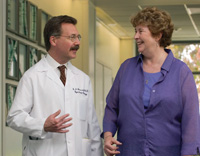
Dr. Gary Leiserowitz, Chief of Gynecologic Oncology at the UC Davis Cancer Center & Rosemary Cress, Research Program Director at the California Cancer Registry, reported that early-stage ovarian cancer patients had nearly twice the risk of death if they were not tested for lymph node metastases.
A team of University of California (UC) Davis Cancer Center and California Cancer Registry researchers determined that more than a quarter of women with apparent early ovarian cancer do not receive lymph node biopsies, which have been shown to improve patient survival.
For the study, the researchers identified patients diagnosed with apparent early-stage epithelial ovarian cancer between 1998 and 2000 from cancer registries in New York and California, then collected detailed information from patient medical records on the types of surgical staging procedures performed on 721 of the patients.
The study set forth the critical findings below.
- Approximately 90 percent of patients had removal of the omentum and evaluation of the bowel serosa and mesentery. In contrast, only 72 percent of patients with presumed early-stage disease had lymph nodes from the pelvis and abdomen tested for signs of cancer spread, despite the existence of published, professional guidelines for proper staging of the disease.
- Only lymph node assessment (as well as node assessment combined with washings and omentectomy) had a statistically significant association with improved survival.
- The five-year survival for women with early-stage disease who had the node biopsies was 84 percent, compared with 69 percent of those who did not have the tests.
- Patients who did not have lymph node assessment had nearly twice the risk of death as those who did.
- Stratification of patients based upon receipt of chemotherapy revealed that lack of lymph node sampling had an effect only on patients who also received no chemotherapy. Thus, only when patients did not have the lymph nodes tested did chemotherapy improve survival, a finding the researchers attribute to the role chemotherapy likely plays in killing cancer cells that have spread beyond the ovaries.
- Gynecologic oncologists were nearly six-and-a-half times more likely to perform lymph node biopsies than other surgical specialists, and nearly four times more likely to perform all recommended staging biopsies. (See “Additional Information” below for prior medical study findings, regarding the importance of gynecologic oncologists in the evaluation and treatment of ovarian cancer.)
The study results were published online last week in the journal Gynecology Oncology and will be published in the journal’s April print edition.
“Early-stage patients had nearly twice the risk of death if they didn’t have the lymph nodes tested,” said Rosemary Cress, who is an epidemiologist and research program director at the California Cancer Registry, associate adjunct professor in the Department of Public Health Sciences at UC Davis, and the study’s lead author. “Hopefully, this should raise the awareness among physicians that it’s really important to do lymph node biopsies in these patients.”
Why some surgeons don’t remove lymph nodes during ovary surgery for early-stage cancer patients is a matter of speculation, said Gary Leiserowitz, M.D., chief of Gynecologic Oncology at the UC Davis Cancer Center, who is the senior author of the study. But the tests are important, he said, because patients with positive lymph nodes are given a more advanced stage diagnosis and prescribed follow-up chemotherapy treatment.
“Depending on the knowledge and expertise of the surgeon doing the operation, they may not know they need to do all the biopsies,” said Dr. Leiserowitz. “The literature is pretty consistent in showing that the people who have specialized knowledge in this – gynecological oncologists – are much more likely to follow the guidelines.”
Another reason some surgeons may not perform the lymph node biopsies, he said, is that they don’t believe the patient would benefit, either because of advanced age or because they have other serious illnesses, or both.
“If we have a patient who is medically unsuitable because of their age or medical conditions and is not a candidate for chemotherapy, you wouldn’t do all the staging biopsies,” said Dr. Leiserowitz. “But for a woman, say in her 40’s who is otherwise healthy, it turns out to be critical, because chemotherapy could be lifesaving.”
Leiserowitz said he hopes the results of the study will help educate the medical community and patients about the value of appropriate cancer treatment.
“If you are going to treat someone with a cancer, you really have an obligation to understand what the published practice guidelines are, and adhere to them as well as you can, or refer the patient to someone else who will,” he said.
The study was paid for with a grant from the U.S. Centers for Disease Control and Prevention.
About University of California Davis Cancer Center
University of California (UC) Davis Cancer Center is the only National Cancer Institute- designated center serving the Central Valley and inland Northern California, a region of more than 6 million people. Its top specialists provide compassionate, comprehensive care for more than 9,000 adults and children every year, and offer patients access to more than 150 clinical trials at any given time. Its innovative research program includes more than 280 scientists at UC Davis and Lawrence Livermore National Laboratory. The unique partnership, the first between a major cancer center and national laboratory, has resulted in the discovery of new tools to diagnose and treat cancer. Through the Cancer Care Network, UC Davis is collaborating with a number of hospitals and clinical centers throughout the Central Valley and Northern California regions to offer the latest cancer-care services. For more information, visit cancer.ucdavis.edu.
About the California Cancer Registry
The California Cancer Registry (CCR) is a program of the California Department of Public Health’s Cancer Surveillance and Research Branch (CSRB), and works in collaboration with the Public Health Institute, regional cancer registries, health care providers, cancer registrars, and cancer researchers throughout California and the nation. CSRB collects, analyzes, and disseminates information on cancer incidence and mortality. The statewide population-based cancer surveillance system monitors the incidence and mortality of specific cancers over time and analyzes differential cancer risks cancer by geographic region, age, race/ethnicity, sex, and other social characteristics of the population. It gathers cancer incidence data through CCR, and conducts and collaborates with other researchers on special cancer research projects concerning the etiology, treatment, risk factors, and prevention of specific cancers. In addition, the system is designed to monitor patient survival with respect to the type of cancer, extent of disease, therapy, demographics, and other parameters of prognostic importance. In general, data generated from CCR are utilized as set forth below.
- Monitor the amount of cancer and cancer incidence trends by geographic area and time in order to detect potential cancer problems of public health significance in occupational settings and the environment, and to assist in their investigation.
- Provide information to stimulate the development and targeting of resources to benefit local communities, cancer patients, and their families.
- Promote high-quality epidemiologic and clinical research by enabling population-based studies to be performed that can provide better information for cancer control.
- Inform health professionals and educate citizens regarding specific health risks, early detection, and treatment for cancers known to be elevated in their communities.
- Respond to public concerns and questions about cancer.
For more information, visit http://www.ccrcal.org/.
Sources:
- Ovarian Cancer Spread Missed When Recommended Staging Biopsies Not Performed, UC Davis Researchers Find – Risk of death doubles for those who are not checked for lymph node metastases, Press Release, UC Davis Cancer Center, February 2, 2011.
- Cress RD, Bauer K, O’Malley CD, et. al. Surgical staging of early stage epithelial ovarian cancer: Results from the CDC-NPCR ovarian patterns of care study. Gynecol Oncol. 2011 Jan 20. [Epub ahead of print] PMID: 21256581.
Additional Information — The Role of Gynecologic Oncologists and Their Impact on Survival:
- The Role of Gynecologic Oncologists, Women’s Cancer Network™, Gynecologic Cancer Foundation website.
- Burton E, Chase D, Yamamoto M, et al. Surgical management of recurrent ovarian cancer: the advantage of collaborative surgical management and a multidisciplinary approach. Gynecol Oncol. 2011 Jan;120(1):29-32. Epub 2010 Nov 4. PubMed PMID: 21055797.
- Chan JK, Kapp DS, Shin JY, et. al. Influence of the gynecologic oncologist on the survival of ovarian cancer patients. Obstet Gynecol. 2007 Jun;109(6):1342-50. PubMed PMID: 17540806.
- Vernooij F, Heintz P, Witteveen E, van der Graaf Y. The outcomes of ovarian cancer treatment are better when provided by gynecologic oncologists and in specialized hospitals: a systematic review. Gynecol Oncol. 2007 Jun;105(3):801-12. Epub 2007 Apr 12. Review. PubMed PMID: 17433422.
- Engelen MJ, Kos HE, Willemse PH, et. al. Surgery by consultant gynecologic oncologists improves survival in patients with ovarian carcinoma. Cancer. 2006 Feb 1;106(3):589-98. PubMed PMID: 16369985.
- Earle CC, Schrag D, Neville BA, et. al. Effect of surgeon specialty on processes of care and outcomes for ovarian cancer patients. J Natl Cancer Inst. 2006 Feb 1;98(3):172-80. PubMed PMID: 16449677.


 Libby's H*O*P*E*