
Fred Hutchinson Cancer Center researchers discovered that concentrations of the serum biomarkers CA125, human epididymis protein 4 (HE4), and mesothelin began to rise 3 years before clinical diagnosis of ovarian cancer, according to a new study published online December 30 in the Journal of the National Cancer Institute. However, the biomarkers became substantially elevated only in the last year prior to diagnosis. … In an accompanying editorial to the study results reported by Anderson et. al., Patricia Hartge, ScD, of the Division of Cancer Epidemiology and Genetics at the National Cancer Institute, applauds the researchers for taking the field one step closer to successful screening study designs by showing that the levels of certain biomarkers do not increase early enough to be used for screening.
Fred Hutchinson Cancer Center researchers discovered that concentrations of the serum biomarkers CA125, human epididymis protein 4 (HE4), and mesothelin began to rise 3 years before clinical diagnosis of ovarian cancer, according to a new study published online December 30 in the Journal of the National Cancer Institute (JNCI). [1] However, the biomarkers became substantially elevated only in the last year prior to diagnosis.

Garnet L. Anderson, Ph.D., Division of Public Health Sciences, Fred Hutchinson Cancer Research Center, Seattle, WA.
CA125, HE4, mesothelin, B7-H4, decoy receptor 3, and spondin-2 have been identified as potential ovarian cancer serum biomarkers, but their behavior in the prediagnostic period, with the exception of CA125, has not been evaluated. In the JNCI study, Garnet L. Anderson, Ph.D., of the Division of Public Health Sciences at the Fred Hutchinson Cancer Research Center in Seattle, and colleagues analyzed prediagnostic serum samples and patient data from the Carotene and Retinol Efficacy Trial (CARET), a randomized, double-blind, placebo-controlled chemoprevention trial testing the effects of beta-carotene and retinol on lung cancer incidence among individuals at high risk for lung cancer. Prediagnostic serum samples (taken up to 18 years prior to diagnosis) were obtained for 34 CARET patients with ovarian cancer and 70 matched control CARET subjects. Changes in the levels of these biomarkers prior to ovarian cancer diagnosis were analyzed.
Anderson et. al. discovered that concentrations of CA125, HE4, and mesothelin (but not B7-H4, decoy receptor 3, and spondin-2) began to increase slightly in cancer patients relative to control subjects approximately 3 years before diagnosis, but became substantially elevated within one year prior to diagnosis. Thus, the diagnostic value of these biomarkers is limited because accuracy only increased shortly before diagnosis. “Although these markers are not accurate enough to prompt early intervention in existing screening protocols, the multivariable regression analyses identified modest but statistically significant increases in risk associated with CA125, HE4, and mesothelin, which are consistent with many of the established epidemiological risk factors for ovarian cancer,” say the authors of the study.
“I still think biomarkers may play a role in a cost-effective screening program, although none of these seem accurate enough either alone or together to justify their use in average-risk women,” Anderson told Medscape Oncology. “I do not know of any other currently identified biomarkers that hold more promise than these, but there has been a massive effort over the last few years to identify candidates and not all have been thoroughly vetted,” said Dr. Anderson.
One problem, cites Dr. Anderson, may lie in the approach used in identifying potential ovarian cancer biomarkers. “Most of the discovery work done so far has been conducted in women with advanced-stage disease and compared them to healthy women,” she explained. “If discovery work were done in samples like the ones we used here, representing specimens collected months to years prior to the advanced stage diagnosis, we might have a better chance of finding earlier signals of aggressive disease.”
Another opportunity for improving screening and early diagnosis lies in imaging, she adds. “Currently the most common and only affordable imaging option that could be considered for routine screening is transvaginal ultrasound, but it performs poorly in terms of accurately determining those women [who] have ovarian cancer from those who do not,” said Dr. Anderson. “A substantial improvement in this area would be very exciting.”
Study Limitations Cited By JNCI Editors
The JNCI editors state three limitations that they believe are associated with the study by Anderson et. al. First, the study sample size was small. Second, all women who participated in CARET had a history of heavy smoking, and therefore, the JNCI editors believe that the blood serum testing results obtained by Anderson et. al. may not apply to other non-smoking groups. Third, the blood collected from women participating in CARET was collected at different times, but only a few samples were collected during the last 2–3 years before ovarian cancer diagnosis.
Designing Ovarian Cancer Early Detection Programs — Accompanying JNCI Editorial

Patricia Hartge, Sc.D. Deputy Director, Epidemiology and Biostatistics Program, Division of Cancer Epidemiology & Genetic, National Cancer Institute
In an accompanying editorial to the study results reported by Anderson et. al., Patricia Hartge, ScD, of the Division of Cancer Epidemiology and Genetics at the National Cancer Institute, applauds the researchers for taking the field one step closer to successful screening study designs by showing that the levels of certain biomarkers do not increase early enough to be used for screening. [2]
Dr. Hartge notes that despite the discovery that CA125 and other serum markers increase before the clinical onset of ovarian cancer, it has been exceedingly difficult to devise a successful ovarian cancer early screening program for asymptomatic women. Nevertheless, Hartge believes that Anderson et al. take a valuable step toward the design of such a successful screening program by demonstrating why screening regimens that are based on markers, or panels of markers, can fail. Specifically, the researchers discovered that blood levels of CA125, HE4, mesothelin, and three other promising markers did not increase early enough in the course of the disease to allow detection in early stages. Dr. Hartge emphasizes that the markers typically rose within one year of the disease symptoms that led to an accurate diagnosis, and therefore, many of the ovarian cancer patients were diagnosed with advanced stage disease.
Hartge further states “[t]hat the results of Anderson et al. are not the last word in serum markers or in combinations of markers.” “Serum markers likely will form a key element in any screening regimen, with the lead time and other parameters of each marker or combination of markers being taken into account. The careful evaluation technique applied in the current study fits into a staged approach necessary for testing performance of early markers of disease.” Hartge adds that “[o]nly the time-consuming, expensive, and demanding randomized clinical trial can reveal whether an early detection program that includes the biomarkers can save lives.”
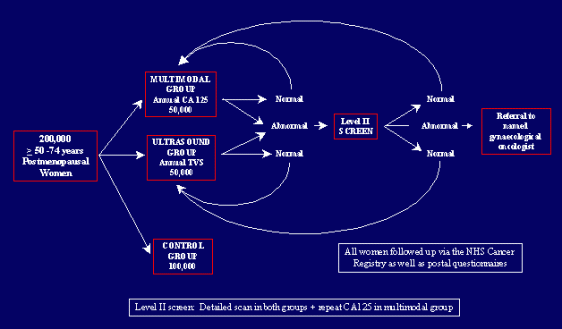
In support of her position, Dr. Hartge observes that current randomized trials are testing the value of different screening programs that are built on combinations of CA125, ultrasound, and risk factor data (e.g., family history and age). After four rounds of screening 34,261 postmenopausal women for ovarian cancer with both CA125 and ultrasound, University of Alabama at Birmingham School of Medicine investigators of the large U.S. screening trial observed that the predictive value of a positive screen was quite low — approximately 1%. Of the 60 screen-detected cancers, 72% had already advanced to at least stage III. [3] In addition, of every 20 women who underwent surgery after a positive screen, only one women was diagnosed with cancer. Furthermore, in a recent UK trial with a slightly different design, positive predictive values from the first round of screening were higher; 35% in the 50,078 women whose risk was assessed with CA125 and risk factor data, followed by ultrasound only if indicated, and 3% in the 50,639 women screened first with ultrasound. [4] The effects on mortality in both trials remain to be determined.
Confronting The “Daunting Arithmetic” Required To Detect Early Stage Ovarian Cancer
Based upon the foregoing, Dr. Hartge highlights the “daunting arithmetic” required to detect early stage ovarian cancer. In the U.S., Surveillance, Epidemiology and End Results (SEER) data indicates that incidence amounts to 13 cases of ovarian cancer per 100,000 woman per year, referred to by Dr. Hartge as the “proverbial needles in the haystack.” [5] So as not to present a problem without a potential solution, Hartge provides a roadmap to additional factors that may help future researchers develop early screening methods to identify those rare cases of ovarian cancer in the general population. Notably, SEER data also indicates that incidence of ovarian cancer steadily increases with age from 21 cases per 100,000 women per year within the 50-54 age range to 57 cases per 100,000 women per year within the 80-84 age range. [6] Furthermore, family history, low parity, and more ovulations over a woman’s lifetime predict additional risk, with the strongest but least common predictor being a mutation in the BRCA1 or BRCA2 gene. Thus, the general approach suggested by Hartge focuses on women with higher baseline risks, for whom the predictive value of a positive serum test tends to increase. Dr. Hartge believes that the performance of an overall screening program will improve by targeting higher-risk subgroups of women for screening by combining personal history, genetic abnormality status, and levels of serum markers in one prediction model. With ongoing advances in understanding the origin and causes of ovarian cancer, Hartge states that the risk models that are useful for screening programs should also improve.
Further technology advancements may also improve future ovarian cancer early detection screening models, says Hartege. For example, a screening program that is based on a panel of biomarkers can be improved by developing new medical imaging technology that is more specific than current ultrasound technology. If better imaging existed, fewer women would undergo surgery following a suspicious biomarker finding. Similarly, development of less invasive surgery could further reduce harmful side effects. Although Hartge observes that a highly accurate biomarker(s) or an overall screening program does not yet exist, she also explains that the current study by Anderson et. al., with its sobering implications, brings future researchers closer to understanding the crucial elements in designing an effective early detection program for ovarian cancer.
References:
1/Anderson GL , McIntosh M, Wu L, et. al. Assessing Lead Time of Selected Ovarian Cancer Biomarkers: A Nested Case–Control Study. Journal of the National Cancer Institute Advance Access published on January 6, 2010, DOI 10.1093/jnci/djp438. J. Natl. Cancer Inst. 102: 26-38.
2/Hartge P. Designing Early Detection Programs for Ovarian Cancer. Journal of the National Cancer Institute Advance Access published on January 6, 2010, DOI 10.1093/jnci/djp450. J. Natl. Cancer Inst. 102: 3-4.
3/Partridge E, Kreimer AR, Greenlee RT, et al. Results from four rounds of ovarian cancer screening in a randomized trial. Obstet Gynecol (2009) 113(4):775–782. [PMCID: PMC2728067; PMID: 19305319].
4/Menon U, Gentry-Maharaj A, Hallett R, et al. Sensitivity and specificity of multimodal and ultrasound screening for ovarian cancer, and stage distribution of detected cancers: results of the prevalence screen of the UK Collaborative Trial of Ovarian Cancer Screening (UKCTOCS). Lancet Oncol (2009) 10(4):327–340. [PMID: 19282241]
5/ Horner MJ, Ries LAG, Krapcho M, et al, eds. SEER Cancer Stat Fact Sheets (2009) Bethesda, MD: National Cancer Institute. http://seer.cancer.gov/statfacts/html/ovary.html. Accessed December 2, 2009.
6/Horner MJ, Ries LAG, Krapcho M, et. al., eds. SEER Cancer Statistics Review, 1975-2006, National Cancer Institute. Bethesda, MD, http://seer.cancer.gov/csr/1975_2006, based on November 2008 SEER data submission, posted to the SEER web site, 2009 [See Table 21.6: Incidence & Mortality Rates By Age].
Sources:
- Biomarkers Not Sufficiently Accurate for Early Intervention in Ovarian Cancer, By Roxanne Nelson, Medscape Medical News, Medscape Today, December 31, 2009 [free Medscape registration may be required to view article].
- Researchers make progress on early detection of ovarian cancer, U.S. & World section, The Los Angeles Times online, December 30, 2009.
- New ovarian cancer findings small but significant step toward early detection, by Carol M. Ostrom, Health section, The Seattle Times online, December 30, 2009.
- Proteins show promise for ovarian cancer screening, by Joanne Allen, News, Reuters U.K., December 30, 2009.
 Libby's H*O*P*E*