To Screen or Not To Screen? Ultrasound + CA125 Blood Test Fail to Detect Early Stage Ovarian Cancer

On March 10, 2009, Libby’s H*O*P*E*™ reported on the preliminary findings of a large British study that suggest that the combination of transvaginal ultrasound and CA125 blood test (a blood serum marker for ovarian cancer) can detect early ovarian cancer.  A recent U.S. study, published in the April 2009 issue of Obstetrics & Gynecology, found that the same combination screening regime did not detect early stage ovarian cancer and often resulted in unnecessary surgery. The U.S. and British studies, taken together, highlight the need to find an effective screening method to detect ovarian cancer.

On March 10, 2009, Libby’s H*O*P*E*™ reported on the preliminary findings of a large British study that suggest that the combination of transvaginal ultrasound and CA125 blood test (a blood serum marker for ovarian cancer) can detect early ovarian cancer.  A recent U.S. study, published in the April 2009 issue of Obstetrics & Gynecology, found that the same combination screening regime did not detect early stage ovarian cancer and often resulted in unnecessary surgery. The U.S. and British studies, taken together, highlight the need to find an effective screening method to detect ovarian cancer.

partridge-edward

Dr. Edward E. Partridge is the Director of the University of Alabama Birmingham Comprehensive Cancer Center, Birmingham, Alabama.

In a recent interview with U.S. News & World Report, the lead researcher of the U.S. study, Dr. Edward Partridge, Director of the University of Alabama Birmingham Comprehensive Cancer Center, said, “The jury is still out on the efficacy of screening with CA125 and transvaginal ultrasound in terms of reducing the mortality rate of ovarian cancer.  In this study, we do not have mortality data on the screening versus the non-screening group, so no conclusions can be made of the impact of screening with CA125 and transvaginal ultrasound.”

Partridge noted that this study only reports data on women who were screened. “We learned that the positive predictive value for the combination of tests is pretty low — in the 1 to 1.3 percent range,” he said. “A substantial number of the tests are false positives.”  In addition, screening with transvaginal ultrasound lead to a higher rate of surgery for positive findings than positive CA125, Partridge said. “Transvaginal ultrasound leads to more ‘unnecessary’ surgeries,” he said.  Partridge also noted that a high percentage of the cancers detected through screening were late-stage malignancies.  “If you detect them at a late stage, it is unlikely that you are going to impact mortality,” he said. “In order to affect mortality, one has to detect them at an earlier stage.”

As part of the study, the U.S. researchers collected data on 34,261 women who underwent annual screening for CA125 and also had transvaginal ultrasound.  A CA 125 value at or above 35 units/mL or an abnormality on transvaginal ultrasound was considered a “positive” screen.  The researchers found that  transvaginal ultrasound produced more positive findings for cancer than CA125 screening over the four years of screening, while the CA125 positive tests decreased from 60 percent in the first year to 34 percent in the third year.  Of the 89 invasive ovarian cancers diagnosed, 60 were detected through screening. In addition, 72 percent of the screen-detected cancer were late-stage cancers, the U.S. researchers reported.

Partridge told U.S. News & World Report that even detecting cancer early may not have an impact on mortality. “In any screening trial, the ultimate test of its usefulness is does it impact mortality,” he said.  Patridge added that based upon the findings of this study and The United Kingdom Collaborative Trial of Ovarian Cancer Screening (UKCTOCS) study published by Menon et. al. in the March 10 online edition of  The Lancet Oncology, the CA125 blood test & ultrasound screening method will not have any effect on mortality. “What we need is a more sensitive and specific screening test,” Partridge said.

In the UKCTOCS study, a British research team found that screening was able to identify most women with gynecologic cancer. The combination of the CA125 blood test and ultrasound found 90 percent of the cancers, while ultrasound alone found 75 percent of the cancers.  The researchers also found that almost 50 percent of all the cancers found were in an early stage (stage I or II).  And, 48 percent of the more invasive ovarian cancers detected were designated as being stage I tumors. By way of comparison, the British researchers pointed out that only 28 percent of ovarian cancers are identified in this early stage.

Dr. David G. Mutch, the Ira C. and Judith Gall Professor of Obstetrics and Gynecology at Washington University, St. Louis, and author of an accompanying journal editorial, agreed there is no worthwhile screening test for ovarian cancer as yet.  “Patients who were screened presented at the same stage as they would have if they were unscreened,” Mutch said. “There is no good screening test at this point.”  Mutch added that there is no reason to screen for ovarian cancer in the general population at this point. “The prevalence of the diseases is so low, one in 2,500, and the specificity of the tests are so low, that we are going to operate on a lot of patients unnecessarily,” he said.

Primary Sources:

Preliminary Findings of a Large British Study Indicate That CA-125 Blood Test & Transvaginal Ultrasound Test Can Detect Early Ovarian Cancer

“Ovarian cancer has a high case—fatality ratio, with most women not diagnosed until the disease is in its advanced stages. The United Kingdom Collaborative Trial of Ovarian Cancer Screening (UKCTOCS) is a randomised controlled trial designed to assess the effect of screening on mortality. This report summarises the outcome of the prevalence (initial) screen in UKCTOCS. …”

“Background

Ovarian cancer has a high case—fatality ratio, with most women not diagnosed until the disease is in its advanced stages. The United Kingdom Collaborative Trial of Ovarian Cancer Screening (UKCTOCS) is a randomised controlled trial designed to assess the effect of screening on mortality. This report summarises the outcome of the prevalence (initial) screen in UKCTOCS.

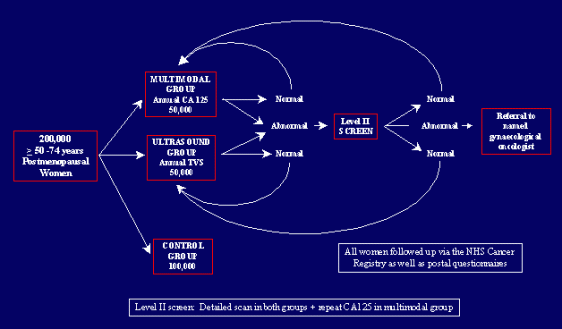
earlydetecttrialdesign1

The United Kingdom Collaborative Trial of Ovarian Cancer Screening - Overall Trial Design

Methods

Between 2001 and 2005, a total of 202,638 post-menopausal women aged 50—74 years were randomly assigned to [1] no treatment (control; n=101,359); [2] annual CA125 screening (interpreted using a risk of ovarian cancer algorithm) with transvaginal ultrasound scan as a second-line test (multimodal screening [MMS]; n=50,640); or [3] annual screening with transvaginal ultrasound (USS; n=50,639) alone in a 2:1:1 ratio using a computer-generated random number algorithm. All women provided a blood sample at recruitment. Women randomised to the MMS group had their blood tested for CA125 and those randomised to the USS group were sent an appointment to attend for a transvaginal scan. Women with abnormal screens had repeat tests. Women with persistent abnormality on repeat screens underwent clinical evaluation and, where appropriate, surgery. This trial is registered as ISRCTN22488978 and with ClinicalTrials.gov, number NCT00058032.

Findings

In the prevalence screen, 50,078 (98.9%) women underwent MMS, and 48,230 (95.2%) underwent USS. The main reasons for withdrawal were death (two MMS, 28 USS), non-ovarian cancer or other disease (none MMS, 66 USS), removal of ovaries (five MMS, 29 USS), relocation (none MMS, 39 USS), failure to attend three appointments for the screen (72 MMS, 757 USS), and participant changing their mind (483 MMS, 1,490 USS). Overall, 4,355 of 50,078 (8.7%) women in the MMS group and 5,779 of 48,230 (12.0%) women in the USS group required a repeat test, and 167 (0.3%) women in the MMS group and 1,894 (3.9%) women in the USS group required clinical evaluation. 97 of 50,078 (0.2%) women from the MMS group and 845 of 48,230 (1.8%) from the USS group underwent surgery. 42 (MMS) and 45 (USS) primary ovarian and tubal cancers were detected, including 28 borderline tumours (eight MMS, 20 USS). 28 (16 MMS, 12 USS) of 58 (48.3%; 95% CI 35.0—61.8) of the invasive cancers were stage I/II, with no difference (p=0.396) in stage distribution between the groups. A further 13 (five MMS, eight USS) women developed primary ovarian cancer during the year after the screen. The sensitivity, specificity, and positive-predictive values for all primary ovarian and tubal cancers were 89.4%, 99.8%, and 43.3% for MMS, and 84.9%, 98.2%, and 5.3% for USS, respectively. For primary invasive epithelial ovarian and tubal cancers, the sensitivity, specificity, and positive-predictive values were 89.5%, 99.8%, and 35.1% for MMS, and 75.0%, 98.2%, and 2.8% for USS, respectively. There was a significant difference in specificity (p<0.0001) but not sensitivity between the two screening groups for both primary ovarian and tubal cancers as well as primary epithelial invasive ovarian and tubal cancers.

Interpretation

The sensitivity of the MMS and USS screening strategies is encouraging. Specificity was higher in the MMS than in the USS group, resulting in lower rates of repeat testing and surgery. This in part reflects the high prevalence of benign adnexal abnormalities and the more frequent detection of borderline tumours in the USS group. The prevalence screen has established that the screening strategies are feasible. The results of ongoing screening are awaited so that the effect of screening on mortality can be determined.

Funding

Medical Research Council, Cancer Research UK and the Department of Health, UK; with additional support from the Eve Appeal, Special Trustees of Bart’s and the London, and Special Trustees of University College London Hospital.”

Primary Source

Sensitivity and specificity of multimodal and ultrasound screening for ovarian cancer, and stage distribution of detected cancers: results of the prevalence screen of the UK Collaborative Trial of Ovarian Cancer Screening (UKCTOCS); Sensitivity and specificity of multimodal and ultrasound screening for ovarian cancer, and stage distribution of detected cancers: results of the prevalence screen of the UK Collaborative Trial of Ovarian Cancer Screening (UKCTOCS); Usha Menon MD, Aleksandra Gentry-Maharaj Ph.D., Rachel Hallett Ph.D. et. al, The Lancet Oncology, Early Online Publication, 11 March 2009 doi:10.1016/S1470-2045(09)70026-9.

Comment

During an interview with the New York Times, Dr. Ian Jacobs, director of the Institute for Women’s Health at University College London, and director of the trial, discussed the optimism and the caveats associated with the preliminary clinical study results as follows:

We have now demonstrated we can pick up the vast majority of women with ovarian cancer earlier than they would have otherwise been detected and before they have symptoms, .. and that a good proportion of those women have earlier stage disease than we would normally expect them to have. … [W]omen thinking of having this must understand and realize that there’s a possibility it will do more harm than good. We have reason to think it will save lives, … and then the question is, will it save enough lives to balance out the harm it does? [Emphasis added].

Robert Smith, director of cancer screening for the American Cancer Society informed the New York Times that “[w]e’re not even remotely close to knowing how to screen women of average risk with these tests, or even if we should.” Mr Smith added that it is important to run large clinical trials, but that the preliminary results of this study must be interpreted with caution.

Secondary Sources