Derivative Vitamin A Compound Prevents Ovarian Cancer In the Lab

…The compound, which still faces several rounds of clinical trials, successfully stopped normal cells from turning into cancer cells and inhibited the ability of tumors to grow and form blood vessels. If successful tests continue, researchers eventually hope to create a daily pill that would be taken as a cancer preventive. …”

“While researching new ways to stop the progression of cancer, researchers at the University of Oklahoma Health Sciences Center, have discovered a compound that has shown to prevent cancer in the laboratory. The compound, which still faces several rounds of clinical trials, successfully stopped normal cells from turning into cancer cells and inhibited the ability of tumors to grow and form blood vessels. If successful tests continue, researchers eventually hope to create a daily pill that would be taken as a cancer preventive. ‘This compound was effective against the 12 types of cancers that it was tested on,’ said Doris Benbrook, Ph.D., principle investigator and researcher at the OU Cancer Institute. ‘Even more promising for health care is that it prevents the transformation of normal cells into cancer cells and is therefore now being developed by the National Cancer Institute as a cancer prevention drug.’

The synthetic compound, SHetA2, a Flex-Het drug, directly targets abnormalities in cancer cell components without damaging normal cells. The disruption causes cancer cells to die and keeps tumors from forming. Flex-Hets or flexible heteroarotinoids are synthetic compounds that can change certain parts of a cell and affect its growth. Among the diseases and conditions being studied for treatment with Flex-Hets are polycystic kidney disease, kidney cancer and ovarian cancer. Benbrook and her research team have patented the Flex-Het discovery and hope to start clinical trials for the compound within 5 years. If the compound is found to be safe, it would be developed into a pill to be taken daily like a multi-vitamin to prevent cancer.

The compound also could be used to prevent cancer from returning after traditional radiation and chemotherapy treatments, especially in cancers that are caught in later stages such as ovarian cancer where life expectancy can be as short as 6 months after treatment. ‘It would be a significant advancement in health care if this pill is effective in preventing cancer, and we could avoid the severe toxicity and suffering that late stage cancer patients have to experience,’ Benbrook said.”

[Quoted Source: “Chemical Compound Prevents Cancer In Lab,” Science News, ScienceDaily, May 14, 2008].

Additional Information: The foundational in vivo study performed by Benbrook et. al. involving use of various retinoids, including SHetA2, against ovarian cancer is entitled, Effects of Retinoids on Cancerous Phenotype and Apoptosis in Organotypic Cultures of Ovarian Carcinoma, Benbrook, D. et. al; Journal of the National Cancer Institute, Vol. 93, No. 7, 516-525, April 4, 2001. Click here for full text Adobe PDF copy.

Global Consortium Formed To Hunt For Cancer Genes

“The International Cancer Genome Consortium is one of most ambitious biomedical research efforts since the Human Genome Project. The consortium will help to coordinate current and future large-scale projects to understand the genomic changes involved in cancer. This genomic information will accelerate efforts to develop better ways of diagnosing, treating and preventing many types of cancer.”

“Toronto, April 29, 2008 –Research organizations around the world announced today that they are launching the International Cancer Genome Consortium (ICGC), a collaboration designed to generate high-quality genomic data on up to 50 types of cancer through efforts projected to require up to a decade. The ICGC, which is extending an invitation to all nations to participate, will make its data rapidly and freely available to the global research community.

Each ICGC member intends to conduct a comprehensive, high-resolution analysis of the full range of genomic changes in at least one specific type or subtype of cancer, with studies built around common standards of data collection and analysis. Each project is expected to involve specimens from approximately 500 patients and have an estimated cost of $20 million (U.S.).

As part of its coordination efforts, the ICGC will generate a list of approximately 50 cancer types and subtypes that are of clinical significance around the globe. ICGC members plan to assume responsibility for specific cancers, and one of the ICGC’s roles will be to facilitate the exchange of information so participants’ efforts do not duplicate each other.

Current ICGC members include:

* Australia: National Health and Medical Research Council (Observer Status)
* Canada: Genome Canada (Observer Status); Ontario Institute for Cancer Research
* China: Chinese Cancer Genome Consortium
* Europe: European Commission (Observer Status)
* France: Institut National du Cancer
* India: Department of Biotechnology, Ministry of Science & Technology
* Japan: RIKEN; National Cancer Center
* Singapore: Genome Institute of Singapore
* United Kingdom: The Wellcome Trust; Wellcome Trust Sanger Institute
* United States: National Institutes of Health

‘Clearly, there is an urgent need to reduce cancer’s terrible toll. To help meet that need, the Consortium will use new genome analysis technologies to produce comprehensive catalogs of the genetic mutations involved in the world’s major types of cancer,’ said Thomas Hudson, MD, of the ICGC Secretariat, which is based at the Ontario Institute for Cancer Research in Toronto. ‘Such catalogs will be valuable resources for all researchers working to develop new and better ways of diagnosing, treating and preventing cancer.’

Worldwide, more than 7.5 million people died of cancer and more than 12 million new cases of cancer were diagnosed in 2007. Unless progress is made in understanding and controlling cancer, those numbers are expected to rise to 17.5 million deaths and 27 million new cases in 2050.

Once thought of as a single disease, cancer is now understood to consist of a large number of different conditions. In almost all forms, however, cancer changes the genetic blueprint, or genomes, of cells, and causes disruptions within normal biological pathways, leading to uncontrolled cell growth. Because genomic changes are often specific to a particular type or stage of cancer, systematically mapping the changes that occur in each cancer could provide the foundation for research to identify new therapies, diagnostics and preventive strategies.

The ICGC’s main criteria for prioritizing cancer types will be: impact, including incidence and mortality rates, availability of therapies and age of onset; scientific interest; and feasibility, which includes the ability to obtain enough high-quality samples to conduct a large-scale project.

To facilitate comparisons among different types of cancer, the ICGC guidelines list key factors for its members to consider in the production of genomic catalogs. Those factors include comprehensiveness, which involves detecting all cancer genes mutated in at least 3 per cent of tumor samples; resolution, which involves generating data at the level of individual DNA bases; quality, which involves monitoring based on common standards for pathology and technology; and controls, which involves comparisons of data from matched, non-tumor tissue.

ICGC member nations plan to agree to common standards for informed consent and ethical oversight. While the informed consent process will necessarily differ according to each member country’s requirements, the consortium’s policies state that cancer patients enrolled in an ICGC-related study should be informed that their participation is voluntary, that their clinical care will not be affected by their participation and that data obtained from analyses using their samples will be made available to the international research community. ICGC members will ensure that all samples will be coded and stored in ways that protect the identities of the participants in the study.

To maximize the public benefit from ICGC member research, data will be made rapidly available to qualified investigators. In addition, all consortium participants will agree not to file any patent applications or make other intellectual property claims on primary data from ICGC projects.

The ICGC is open to all entities that agree to its policies and guidelines. A white paper detailing those policies and guidelines is available on the consortium’s Web site at www.icgc.org.

The International Cancer Genome Consortium is one of most ambitious biomedical research efforts since the Human Genome Project. The consortium will help to coordinate current and future large-scale projects to understand the genomic changes involved in cancer. This genomic information will accelerate efforts to develop better ways of diagnosing, treating and preventing many types of cancer.

For more information and updates about ICGC activities, go to www.icgc.org”

[Source: “Scientists Form International Cancer Genome Consortium,” International Cancer Genome Consortium, PressRelease dated April 29, 2008.]


Small Phase I Study Reports 2 to 4 Year Ovarian Cancer Remission in 30% of Women Who Received a NY-ESO-1 Vaccine

Three of nine patients (33%) remain in complete clinical remission at 25, 38, and 52 months, respectively.

The cancer-testis antigen NY-ESO-1 is expressed in greater than 40% of advanced epithelial ovarian cancers and represents a promising immunotherapeutic target. In a small Phase I (safety and immunogenicity) clinical trial conducted by Memorial Sloan-Kettering Cancer Center and Cornell University Medical College, nine “high-risk” epithelial ovarian cancer patients, who were in first clinical remission after primary surgery and chemotherapy, received NY-ESO-1b peptide and Montanide ISA-51 every 3 weeks in the form of five vaccinations. The “high risk” ovarian cancer patient criterion was defined as a patient who (i) received suboptimal primary debulking (remaining tumor masses with diameter of 1.0 cm or greater), or (ii) experienced a failure to normalize the CA 125 blood tumor marker by the end of the third cycle of first-line chemotherapy. In addition, each patient enrolled in the trial was required to test positive for (i) human leukocyte antigen 2A (HLA-2A) in the blood, and (ii) NY-ESO-1 or LAGE-1 tumor expression. NY-ESO-1 tumor expression was evaluated for each patient by immunohistochemistry (IHC). LAGE-1 tumor expression was evaluated for each patient by reverse transcriptase and polymerase chain reaction (RT-PCR) analysis. For each patient, NY-ESO-1 specific humoral immunity (ELISA), T-cell immunity (tetramer and ELISPOT), and delayed-type hypersensitivity were assessed pre-vaccination and at week #1, week #4, week #7, week #10, week #13, and week #16 of the vaccination period.

The nine patients experienced treatment-related adverse events including: grade 1 fatigue, anemia, pruritus, myalgias, and hyperthyroidism; and grade 2 hypothyroidism. There were no grade 3/grade 4 adverse events. The results of the Phase I trial are set forth below.

  • Three of four patients (75%) with NY-ESO-1-positive tumor showed T-cell immunity.
  • Four of five patients (80%) with NY-ESO-1-negative tumor showed T-cell immunity.
  • At median follow-up of 11.3 months, six of nine patients (67%) have recurred, with a median progression-free survival (PFS) of 13 months.
  • Three of nine patients (33%) remain in complete clinical remission at 25, 38, and 52 months, respectively.

At the end of the Phase I trial, the trial investigators concluded that vaccination of high-risk, HLA-A2-positive epithelial ovarian cancer patients with NY-ESO-1b and Montanide has minimal toxicity and induces specific T-cell immunity in patients with both NY-ESO-1-positive and NY-ESO-1-negative tumors. Also, the trial investigators noted that additional study is necessary. For a copy of the clinical trial protocol associated with this trial, click here.

[Source: “Safety and Immunogenicity Study of NY-ESO-1b Peptide and Montanide ISA-51 Vaccination of Patients with Epithelial Ovarian Cancer in High-Risk First Remission;” Diefenbach, C.S. et. al.; Clin Cancer Res. 2008 May 1;14(9):2740-2748.]

Comment: Prior cancer vaccines targeting NY-ESO-1 overexpression in ovarian cancer tumors produced moderate success in terms of an increase in PFS. This study is particularly provocative because patients who tested positive and negative for NY-ESO-1 tumor expression experienced T-cell immunity, and “high risk” patients (including suboptimally debulked patients) experienced PFS benefit.

Related Information:

Distinguised Designer Takes a Stand With Ovations For The Cure For Women’s National Health Week

“Natick, Mass. May 6, 2008 – Ovations for the Cure has partnered with Carmen Marc Valvo to raise funds for ovarian cancer research through a sneak peek of the distinguished designer’s Fall 2008 Collection on May 9, 2008 at Natick Collection in Natick, Massachusetts.

The Sisterhood: Taking a Stand with Style Fashion Show & Luncheon leads directly into Women’s National Health Week (May 11-17), featuring 20 models and 50 designs on a squared-off U shaped runway at the largest retail mall in New England. Carmen Marc Valvo, whose fashion designs have graced celebrities such as Beyoncé, Lucy Liu, Oprah Winfrey, Kim Cattrall, Queen Latifah, Radha Mitchell, Vanessa Williams, Catherine Zeta-Jones, Goldie Hawn and Kate Winslet, discovered he had colon cancer in the fall of 2003. Mr Valvo’s early diagnosis helped saved his life. Early diagnosis of ovarian cancer is difficult as currently there is no accurate screening test for the ‘silent killer,’ which is the deadliest women’s gynecological cancer with mortality rates approaching 70 percent if not caught in the early stages. ‘The early detection of cancer is just as important as finding a cure,’ said Carmen Marc Valvo. ‘I’m proud to partner with Ovations for the Cure’s efforts to educate women about the early symptoms of ovarian cancer, while funding valuable research initiatives.’ The luncheon event will feature a special appearance by Carmen Marc Valvo and be hosted by Joyce Kulhawik, a two-time ovarian cancer survivor and former arts and entertainment reporter for Boston’s WBZ-TV.

‘We are excited to start Women’s National Health Week with a unique event featuring one of the most respected designers of the red carpet,’ said Debbie Soprano, executive director at Ovations for the Cure. ‘The research that we are able to fund through events such as this will help lead to an accurate screening test for ovarian cancer, increasing the likelihood of early detection and saving women’s lives.’ The Sisterhood: Taking a Stand with Style Fashion Show & Luncheon is Ovations for the Cure’s first event featuring Carmen Marc Valvo and his Collections

.

Pre-Event & Event Interviews Available:

Carmen Marc Valvo – Celebrity designer and colon cancer survivor

– Patricia Franchi Flaherty – Founder/President of Ovations for the Cure and two-time ovarian cancer survivor

Ursula Matulonis, M.D., Assistant Professor of Medicine, Harvard Medical School

– Debbie Soprano, Executive Director of Ovations for the Cure

_____________________________

About Ovations for the Cure

The Ovations for the Cure Foundation, a 501(c)(3) non-profit organization, is dedicated to the relentless pursuit of a cure for ovarian cancer in two critical ways: first by proliferating broad-spectrum awareness of ovarian cancer risk factors and its subtle warning signs; and second, through the continued support of new and ongoing ovarian cancer research and treatment initiatives.”

[Quoted Source: “Distinguised Designer Takes a Stand With Ovations For The Cure For Women’s National Health Week,” ClutchMedia News Release, May 6, 2008.]

Prognosis Improves Over Time For Almost All Ovarian Cancer Survivors

Results showed that 5-year CS [conditional survival] improved for up to 5 years after diagnosis in almost all ovarian cancer groups, more than tripling in stage IV patients from 17 to 56 percent.

“Continuing prognosis improvement encouraging in ovarian cancer”

By Anita Wilkinson; 06 May 2008Gynecologic Oncology 2008; Advance online publication

“Medwire News: Encouraging study findings suggest that prognosis improves over time for almost all groups of ovarian cancer patients. Ovarian cancer survival is typically estimated from diagnosis, say Mehee Choi (The University of Texas Health Science Center at San Antonio, USA) and colleagues. However, they add that these projections are often discouraging and not necessarily pertinent for patients who have survived the initial treatment period, as prognosis after initial management is not static.

Believing conditional survival (CS) – the probability that patients who have survived for a designated period will be alive for another fixed interval – is more accurate, they applied this measure to 30,738 patients on a National Cancer Institute database [i.e., 1988 -2001 Surveillance Epidemiology and End Results (SEER) data]. Results showed that 5-year CS improved for up to 5 years after diagnosis in almost all ovarian cancer groups, more than tripling in stage IV patients from 17 to 56 percent. Patients with undifferentiated epithelioid histology saw 5-year CS increase from 29 percent at diagnosis to 84 percent after 5 years, and there were also big gains for those with serous histology. Choi et al conclude: ‘Five-year CS probability is an easily understandable measure that can be used to more accurately portray to a patient her current risk profile.’”

[Quoted Source: “Continuing prognosis improvement encouraging in ovarian cancer,” by Anita Wilkinson, MedWire News Release dated May 6, 2008 (discussing the study entitled “Conditional survival in ovarian cancer: Results from the SEER dataset 1988-2001,” Choi M. et. al., Gynecol Oncol. 2008 May;109(2):203-9)].

Testing and Management for Hereditary Breast and Ovarian Cancer

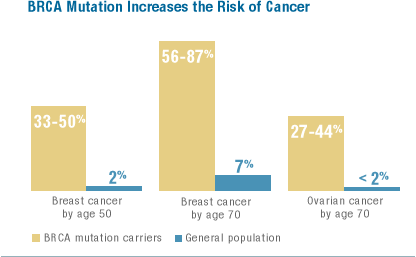
The term “hereditary cancer syndrome” describes an inherited gene mutation that increases the chance to develop one or more types of cancer. For instance, the main hereditary breast cancer syndromes-caused by mutations in the BRCA1 or BRCA2 genes-are also associated with an increased risk for ovarian cancer. Testing is available to identify hereditary breast and ovarian cancer (HBOC) syndrome. Signs of hereditary breast & ovarian cancer syndrome may include, but are not limited to:

  • Breast cancer at age 45 or younger
  • Breast cancer in both breasts in a woman at any age
  • Both breast and ovarian cancer in the same woman
  • Two or more family members with ovarian cancer and/or breast cancer, especially if the breast cancer was diagnosed at or before age 50
  • At least one family member with breast cancer and one with ovarian cancer
  • Breast cancer in men
  • A number of relatives on the same side of the family with breast or ovarian cancer and one of these cancers:

o Prostate cancer
o Pancreatic cancer
o Melanoma

Identifying HBOC is important because there are effective medical options that can reduce the high risk of breast and/or ovarian cancer associated with this syndrome.

The video Making Informed Decisions: Testing & Management for Hereditary Breast and Ovarian Cancer, created by Myriad Genetic Laboratories, Inc., is designed to answer common questions about HBOC syndrome testing and medical management options. In the video, you will meet several women who share their experiences with genetic testing and the use of genetic test results to make decisions regarding their healthcare, including genetic risk management.

Please note that the video is not a substitute for consultation with your doctor. With the information from this video, you should consult with your doctor so as to make the most informed decision possible regarding testing and management of HBOC syndrome.

You can view the 22 minute video by clicking on the hyperlink below. The video viewing screen is located under the “Ovarian Cancer Video Archive” posting dated May 6, 2008.

Making Informed Decisions: Testing & Management for Hereditary Breast and Ovarian Cancer Video

Comment/Additional Resources: For more information regarding HBOC syndrome, genetic testing, genetic counseling & counselors, and genetic risk management, please click the “Genetics” caption tab located at the top of the H*O*P*E* homepage. The BRCA mutation chart above was provided by Myriad Genetics Laboratories, Inc.