When you think of Kathy Bates, you recall immediately her portrayal of “Annie Wilkes” in the movie Misery. In Misery, Kathy Bates, as Annie, holds her favorite author (played by James Caan) hostage. The role of Annie Wilkes earned Kathy Bates an Oscar for “Best Actress.” Her role as the legendary “Unsinkable Molly Brown” in the movie Titanic is also unforgettable. More recently, she re-teamed with her Titanic co-stars Leonardo DiCaprio and Kate Winslet in the movie Revolutionary Road, which is based upon Richard Yates‘ critically acclaimed novel by the same name. Throughout her lengendary career, Kathy Bates has been a talented actress, television director, singer, producer, and composer. Kathy can now add ovarian cancer spokesperson and advocate to her ongoing list of talented roles.
Bates appeared on the TODAY show on January 9th, 2009, to discuss her role in the film Revolutionary Road and her experience with ovarian cancer. The Kathy Bates interview video is provided below through a hyperlink.
In September 2008, and for the first time publicly, Kathy Bates shared the story of her personal fight with ovarian cancer with the Ovarian Cancer National Alliance (OCNA) . With respect to her OCNA interview, Bates said: “As an ovarian cancer survivor, I have decided to join forces with the Ovarian Cancer National Alliance by sharing my story and helping educate women about one of the deadliest cancers affecting women today.” The interview was very personal and in-depth, and Bates shared insights about how she was diagnosed with the disease. The video of the Kathy Bates interview with OCNA is provided below.
Kathy Bates Interview with OCNA
As an ovarian cancer advocate, Ms. Bates also filmed a 30-second TV Public Service Announcement (PSA) about ovarian cancer and its symptoms. Bates’ ovarian cancer PSA was launched in New York City taxi cabs during September 2008, National Ovarian Cancer Awareness month, and continues to run on TV networks nationwide. In response to Kathy Bates’ willingness to speak out about ovarian cancer, Karen Orloff Kaplan, Chief Executive Officer of OCNA, said: “OCNA recognizes the personal strength it took Kathy to talk publicly about her run-in with cancer. We appreciate her willingness to share her story and be an advocate for the organization in its mission to educate women across the country about ovarian cancer.” The ovarian cancer PSA video featuring Kathy Bates is provided below.
Yesterday, Libby’s H*O*P*E* added a new cancer video archive to the weblog courtesy of Vodpod.com. Currently, the archive contains approximately 90 videos that address many general cancer and ovarian cancer issues, as well as the personal voices of those affected by cancer. The new video archive is located on the homepage right sidebar. All you have to do is “click and play.”
Yesterday, Libby’s H*O*P*E* added a new cancer video archive to the weblog courtesy of Vodpod.com. Currently, the archive contains approximately 90 videos that address many general cancer and ovarian cancer issues, as well as the personal voices of those affected by cancer. The new video archive is located on the homepage right sidebar. All you have to do is “click and play.” The video arrangement is set to “random order” so that new videos appear on the homepage sidebar each time you visit Libby’s H*O*P*E*.
If you are aware of a general cancer/ovarian cancer video that is educational, heartfelt, inspirational, humorous, poignant, or is simply dedicated to the one you love, please provide us with the URL address of the video. The URL video address can be sent to us by email (click on the “contact” button located at the top of the homepage), or by comment (post a comment under this post). Upon receipt of the video URL address, we will add the referenced video to the new archive. We appreciate your participation in adding to our video archive and hope you find the archive helpful.
This year, approximately 565,650 Americans are expected to die of cancer — that’s more than 1,500 people a day. … Ovarian cancer causes more deaths than any other cancer of the female reproductive system. … In an unprecedented television event, NBC, ABC, and CBS will simultaneously devote 1 hour of commercial-free prime time to raise funds for the fight against cancer under an initiative called “Standup2cancer.”
What Do You Stand For?
This year, approximately 565,650 Americans are expected to die of cancer — that’s more than 1,500 people a day.
Cancer is the second most common cause of death in the US, exceeded only by heart disease. In the US, cancer accounts for 1 of every 4 deaths.
The budgets for the National Institutes of Health (NIH) and the National Cancer Institute (NCI) have been flat for 5 years. Adjusted for inflation, the NIH budget has fallen 13 percent since 2003, and the NCI budget has fallen 12 percent since 2004.
The NIH estimate overall costs of cancer in 2007 at $219.2 billion:
$89.0 billion for direct medical costs;
$18.2 billion for lost productivity due to illness; and
$112.0 billion for lost productivity due to premature death.
Ovarian Cancer can afflict adolescent, young adult, and mature women, although the risk of disease increases with age and peaks in the late 70s. Pregnancy and the long-term use of oral contraceptives reduce the risk of developing ovarian cancer.
Women who have had breast cancer, or who have a family history of breast cancer or ovarian cancer may have increased risk. Inherited mutations in BRCA1 or BRCA2 genes increase risk. Another genetic syndrome, hereditary nonpolyposis colon cancer, has also been associated with endometrial and ovarian cancer.
Ovarian cancer incidence rates are highest in Western industrialized countries.
Ovarian cancer accounts for about 3% of all cancers among women and ranks #2 among gynecologic cancers.
An estimated 21,650 new ovarian cancer cases are expected in the U.S. in 2008.
An estimated 15,520 ovarian cancer deaths are expected in 2008.
Ovarian cancer causes more deaths than any other cancer of the female reproductive system.
Ovarian cancer is not a “silent” disease; it is a “subtle” disease. Recent studies indicate that some women may experience persistent, nonspecific symptoms, such as (i) bloating, (ii) pelvic or abdominal pain, (iii) difficulty eating or feeling full quickly, or (iv) urinary urgency or frequency. Women who experience such symptoms daily for more than a few weeks should seek prompt medical evaluation. (To learn more about the warning signs and symptoms of ovarian cancer, CLICK HERE).
There is no reliable screening test for the detection of early stage ovarian cancer. Pelvic examination only occasionally detects ovarian cancer, generally when the disease is advanced. However, the combination of a thorough pelvic exam, transvaginal ultrasound, and a blood test for the tumor marker CA125 may be offered to women who are at high risk of ovarian cancer and to women who have persistent, unexplained symptoms like those listed above.
If diagnosed at the localized stage, the 5-year ovarian cancer survival rate is 92%; however, only about 19% of all cases are detected at this stage, usually fortuitously during another medical procedure.
For women with regional and distant metastatic disease, the 5-year ovarian cancer survival rates are 71% and 30%, respectively. The 10-year relative survival rate for all stages combined is 38%.
During 1987-2004, ovarian cancer incidence declined at a rate of 0.9% per year.
Tonight, over 50 of the most renowned personalities in TV, film, sports and music will come together to make history. In an unprecedented television event, NBC, ABC, and CBS will simultaneously devote 1 hour of commercial-free prime time to raise funds for the fight against cancer under an initiative called “Standup2cancer.” In May, Libby’s H*O*P*E*™ covered the opening of the Standup2cancer initiative. [May 30, 2008].
A spectacular line up of talent including Jennifer Aniston, James Taylor, Scarlett Johansson, Meryl Streep, David Cook, Christina Applegate, Lance Armstrong, Jack Black, Kirsten Dunst, Charles Barkley, America Ferrera, Halle Berry, Hilary Swank, Forrest Whitaker, Jimmy Fallon, Keanu Reeves will make personal appearances on the show. These celebrities and more will educate you, move you and entertain you. They will also be on hand to answer your calls in the celebrity phone bank.
To donate, CLICK HERE. The YouTube video below provides an explanation of how the public donations will be used.
SU2C: Where the Money Goes?
The premiere TV performance of “Just Stand Up” – the star studded charitable single in support of Stand Up To Cancer will be performed tonight by legendary recording artists Mariah Carey, Beyonce, Mary J. Blige, Rihanna, Fergie, Sheryl Crow, Miley Cyrus, Melissa Etheridge, Ashanti, Natasha Bedingfield, Keyshia Cole, Ciara, Leona Lewis, LeAnn Rimes, and Carrie Underwood.
“The Fight Back Express is rolling across the nation, carrying the mobile message that Americans have the power to fight cancer in this country with their voices. The American Cancer Society Cancer Action Network (ACS CAN) is sponsoring the 6-month bus tour to highlight the crucial role elected officials play in supporting laws and policies that help people fight cancer. The ACS CAN Fight Back Express kicked off in Ohio in early May and will travel across the 48 continental United States through Election Day, Nov. 4 [2008].”
“TheFight Back Express is rolling across the nation, carrying the mobile message that Americans have the power to fight cancer in this country with their voices. The American Cancer Society Cancer Action Network (ACS CAN) is sponsoring the 6-month bus tour to highlight the crucial role elected officials play in supporting laws and policies that help people fight cancer. The ACS CAN Fight Back Express kicked off in Ohio in early May and will travel across the 48 continental United States through Election Day, Nov. 4 [2008].
‘If one person can fight cancer, then a nation can rise up and defeat it,’ said Daniel E. Smith, president of ACS CAN, the sister advocacy organization of the American Cancer Society. ‘As an essential partner in the fight against cancer, government has a critical role to play in enacting laws and policies that help people battle a disease that will kill an estimated 565,650 people in America this year.’ Scientific discovery alone will not defeat cancer. The federal government is by far the largest source of cancer research funding, but years of budget freezes and cuts are impeding progress.
Through the bus tour, ACS CAN is working to make cancer a higher national priority by educating the public, lawmakers, candidates and the media about the importance of government’s role in defeating cancer. Cancer patients, survivors, caregivers and their families gather at each stop to share their experience with the disease and to voice the need to make dramatic changes in this country’s approach to cancer. ‘We can make this disease history,’ said Bob Willman, an ACS CAN State Lead Ambassador Volunteer from Springfield, Ohio. ‘We know what we need to do to win the war on cancer. Now we need our elected officials to join us and support laws and policies that will help defeat this disease.’
The ACS CAN Fight Back Express is a mobile action center. At each bus stop visitors have the chance to share their story with their Members of Congress through the Picture A Cure program and sign a petition to support access to quality health care for all Americans. The ACS CAN Fight Back Express bus tour comes on the heels of a major public education campaign by ACS CAN and the American Cancer Society, raising awareness about the critical need for access to quality healthcare for all Americans. There has been tremendous progress in the fight against cancer, as evidenced by the reduction in death rates from cancer every year since 1991. But continued success is at risk if Americans don’t have access to cancer prevention, early detection and treatment. More than 47 million people in America are uninsured and countless millions more are underinsured, making them more likely to be diagnosed at later stages when cancers are more deadly. Too often, lifesaving cancer prevention, early detection, and treatment programs are not available to patients who need care the most.
ACS CAN supports evidence-based policy and legislative solutions for a number of cancer-related issues including:
Prevention and Early Detection: Regular screenings can catch cancer at its earliest, most treatable stages, but a federal program that offers low-income and uninsured women screenings for breast and cervical cancer only covers 1 in 5 eligible women. A similar program for colon cancer is now pending before Congress and needs to be created immediately as both of these programs have the potential to save lives.
Increased Funding for Cancer Research: Medical research could lead to the discovery of prevention and early detection tools for the most deadly cancers such as pancreatic and ovarian cancer, but federal research funding has been frozen or cut in recent years, threatening progress.
Tobacco Control: Tobacco is responsible for approximately one-third of all cancer deaths, but the federal government still lacks the ability to regulate tobacco products. At the state and local level, strong smoke-free policies could significantly reduce the number of tobacco-related cancer cases by protecting workers and patrons from the hazards of secondhand smoke.
The Fight Back Express is made possible by the contributions of millions of American Cancer Society and ACS CAN donors across the country whose lives have been touched by cancer. Additionally, the bus tour is made possible by a generous contribution from Pharmaceutical Research and Manufacturers of America (PhRMA). “Incredible progress has been made in recent years in the battle against cancer,” said PhRMA President and CEO Billy Tauzin. ‘America’s pharmaceutical research companies work hard every day to develop new medicines that will enable cancer patients to live longer, healthier, more productive lives. However, scientific research isbut one piece of the puzzle; improved prevention, early detection and access to quality healthcare are equally critical. Together, we can win this fight.’
To find out more about the ACS CAN Fight Back Express and how to make cancer a national priority log on to www.acscan.org. ACS CAN, the nonprofit, nonpartisan advocacy partner of the American Cancer Society, supports evidence-based policy and legislative solutions designed to eliminate cancer as a major health problem. ACS CAN works to encourage elected officials and candidates to make cancer a top national priority. ACS CAN gives ordinary people extraordinary power to fight cancer with the training and tools they need to make their voices heard. For more information, visit www.acscan.org.”
Comment: For additional information regarding the Fight Back Express including: (i) the purchase of miles to keep the bus on the road; (ii) the upcoming Fight Back Express stop locations; and (iii) stories from the roadtrip, please click here. A YouTube video regarding the ACS CAN Fight Back Express bus tour is provided below.
“ASCO and others in the biomedical research community are calling for Congress to increase funding for NIH by $1.9 billion (6.6%) in Fiscal Year 2009 to keep pace with medical research inflation, to reverse the effects of flat funding, and to sustain momentum in biomedical research.”
“Federal Research Funding
Increase Federal Research Funding. Make Your Voice Heard.
The fight against cancer needs your help.
Almost 1.5 million Americans will be diagnosed with cancer this year, and 1 American dies of the disease every minute.
But instead of increasing funding to find new and better cures, our nation’s commitment to funding cancer research is waning. In fact, adjusted for inflation, we have about $500 million less for cancer research than we did just five years ago.
Take Action Now. Sign ASCO’s petition to support increased funding for the National Institutes of Health and the National Cancer Institute.
Background:
The nation’s investment in cancer research is paying off. Cancer deaths are decreasing, survival rates are increasing and treatments are becoming more targeted and with fewer side-effects.
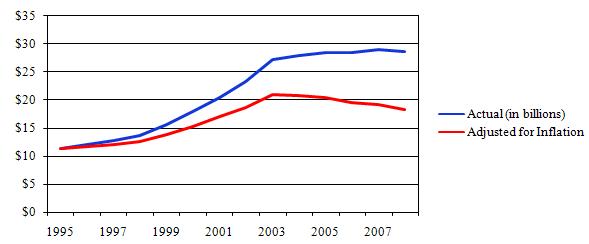
But the United States is in the midst of the longest sustained period of flat funding for cancer research. The budgets for the National Institutes of Health (NIH) and the National Cancer Institute (NCI) have been flat for 5 years. Adjusted for inflation (using the Biomedical Research and Development Price Index), the NIH budget has fallen 13 percent since 2003, and the NCI budget has fallen 12 percent since 2004.
Decline in NIH Purchasing Power: 1995-2007
(Source: Association of American Medical Colleges)
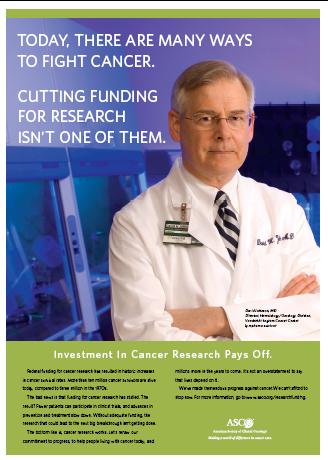
(ASCO Ad in USA Today, June 2, 2008 )
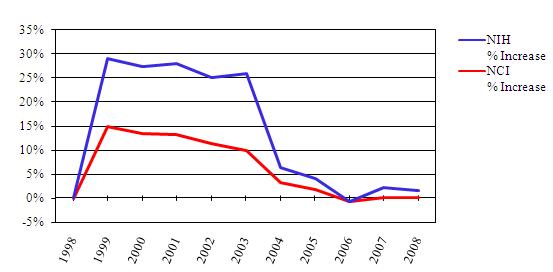
Annual Increase of NIH and NCI Appropriations 1998-2008
(Source: ASCO)
After years of progress, funding for NIH and NCI leveled off and actually decreased in recent years. From 1998 to 2003, funding for NCI increased by 80 percent, allowing for major advances in cancer research . Since that period of rapid growth, NCI’s budget has grown by an average of less than 1 percent annually. In FY 2006, NCI experienced a cut of almost 1 percent.
These declines in the value of NIH and NCI funding threaten to erode the extraordinary recent progress made in biomedical research over the past decade, at a time when scientific potential has never been greater.
ASCO Position:
ASCO and others in the biomedical research community are calling for Congress to increase funding for NIH by $1.9 billion, or 6.6 percent, in FY 2009, to keep pace with medical research inflation, to reverse the effects of flat funding and to sustain momentum in biomedical research. ASCO respects the professional judgment of the NCI in requesting a total of $5.26 billion (a $455 million increase over FY 2008 funding levels). ASCO will work to ensure that Congress approves the largest possible total funding increase to support NIH and cancer research. ASCO is also calling for funding increases over the next several years that at least keep pace with inflation to ensure that progress in cancer research continues.
“Natick, Mass. May 6, 2008 – Ovations for the Cure has partnered with Carmen Marc Valvo to raise funds for ovarian cancer research through a sneak peek of the distinguished designer’s Fall 2008 Collection on May 9, 2008 at Natick Collection in Natick, Massachusetts.
The Sisterhood: Taking a Stand with Style Fashion Show & Luncheon leads directly into Women’s National Health Week (May 11-17), featuring 20 models and 50 designs on a squared-off U shaped runway at the largest retail mall in New England. Carmen Marc Valvo, whose fashion designs have graced celebrities such as Beyoncé, Lucy Liu, Oprah Winfrey, Kim Cattrall, Queen Latifah, Radha Mitchell, Vanessa Williams, Catherine Zeta-Jones, Goldie Hawn and Kate Winslet, discovered he had colon cancer in the fall of 2003. Mr Valvo’s early diagnosis helped saved his life. Early diagnosis of ovarian cancer is difficult as currently there is no accurate screening test for the ‘silent killer,’ which is the deadliest women’s gynecological cancer with mortality rates approaching 70 percent if not caught in the early stages. ‘The early detection of cancer is just as important as finding a cure,’ said Carmen Marc Valvo. ‘I’m proud to partner with Ovations for the Cure’s efforts to educate women about the early symptoms of ovarian cancer, while funding valuable research initiatives.’ The luncheon event will feature a special appearance by Carmen Marc Valvo and be hosted by Joyce Kulhawik, a two-time ovarian cancer survivor and former arts and entertainment reporter for Boston’s WBZ-TV.
‘We are excited to start Women’s National Health Week with a unique event featuring one of the most respected designers of the red carpet,’ said Debbie Soprano, executive director at Ovations for the Cure. ‘The research that we are able to fund through events such as this will help lead to an accurate screening test for ovarian cancer, increasing the likelihood of early detection and saving women’s lives.’ The Sisterhood: Taking a Stand with Style Fashion Show & Luncheon is Ovations for the Cure’s first event featuring Carmen Marc Valvo and his Collections
– Debbie Soprano, Executive Director of Ovations for the Cure
_____________________________
About Ovations for the Cure
The Ovations for the Cure Foundation, a 501(c)(3) non-profit organization, is dedicated to the relentless pursuit of a cure for ovarian cancer in two critical ways: first by proliferating broad-spectrum awareness of ovarian cancer risk factors and its subtle warning signs; and second, through the continued support of new and ongoing ovarian cancer research and treatment initiatives.”
[Quoted Source: “Distinguised Designer Takes a Stand With Ovations For The Cure For Women’s National Health Week,” ClutchMedia News Release, May 6, 2008.]
The ovarian cancer survivor highlighted this week is Maddie Kullen. Mattie is different from virtually all other ovarian cancer survivors because she was diagnosed with the disease when she was 6 years old. Upon diagnosis, Maddie had a 6-inch tumor removed at Children’s Hospital Boston, followed by 16 weeks of chemotherapy. Maddie’s treatments are now over and she is cancer-free.
If you think a 6 year old cannot make a difference in the fight against ovarian cancer, you are absolutely wrong. Maddie is a spokesperson for Ovations for the Cure and participated in that group’s ovarian cancer awareness public service announcement. Maddie was also part of the Boston Marathon Jimmy Fund Walk. Her best idea was the creation of a program at Children’s Hospital Boston that provides young cancer patients with an ice cream break each week. This program is called “Sundaes on Saturday,” and it is supported by monies raised through Kullen family fundraisers. Please take time to watch Maddie’s ovarian cancer awareness public announcement below and visit Ovations for the Cure if you are interested in finding out more about the mission of that group.
When asked by a WBZTV Boston journalist to comment on her appearance in the Ovations for the Cure ovarian cancer awareness spot, Maddie simply responded, “Cool! And then once I saw the commercial I went back to watching kid shows.”
Comment: Although Maddie’s ovarian cancer diagnosis represents an extremely rare case, it is important to note that ovarian cancer does not discriminate when it comes to age, race or financial status. For more information regarding the early warning signs and symptoms of ovarian cancer, visit the H*O*P*E* blog page entitled, “Warning Signs and Symptoms.”
Maddie Kullen in Ovations For the Cure Ovarian Cancer Public Service Announcement
Johanna’s Law is named after Johanna Silver Gordon, a dynamic woman and former schoolteacher, who lost her life to ovarian cancer despite being a health conscious woman who visited the gynecologist regularly. Sadly, Johanna did not recognize the early symptoms and warning signs of ovarian cancer until AFTER being diagnosed with an advanced stage of the disease. Lack of symptom recognition contributed to a lengthy —and ultimately lethal — delay in Johanna’s diagnosis. Tragically, Johanna’s story of delayed diagnosis is all too common. Thousands of U.S. women annually are stunned not only by diagnoses of gynecologic cancer, but also learn after the fact that the symptoms experienced in the months prior to their diagnoses were common symptoms of these cancers. The problem is particularly common with respect to ovarian cancer, where a pervasive lack of knowledge regarding symptoms commonly leads to lengthy delays in disease diagnosis. Additionally, women are frequently misdiagnosed with benign conditions before the correct diagnosis is made by a health care professional.
The Gynecologic Cancer Education and Awareness Act (P.L. 109-475) was passed by the 109th Congress and signed into law in early 2007. This law provides up to $16.5 million for awareness and education through a national public service campaign that will include written materials and public service announcements.
The passage of Johanna’s Law was required because too many women are diagnosed in later stages of gynecologic cancers; if these women were diagnosed earlier, their chances of survival would be greater. Women with ovarian cancer have a five-year relative survival rate of more than 90 percent if diagnosed in Stage I. Unfortunately, less than 20 percent of ovarian cancer cases are diagnosed in Stage I. The overall five-year relative survival rate for ovarian cancer is 45 percent. Due to the lack of an early screening test for ovarian cancer (however, see Yale Blood Test Detects Early Stage Ovarian Cancer with 99% Accuracy), women and health care providers must be aware of the signs and symptoms of gynecologic cancers to act in the best interests of women.
Legislative History
In 2004, the bill was introduced in the U.S. House of Representativies (House). In 2005, the bill was introduced in the U.S. Senate (Senate). The House held a hearing on the bill in 2006. It was passed by unanimous consent of the Senate in 2006 and signed into law by President George W. Bush in early 2007. The Ovarian Cancer National Alliance (the Alliance) worked to secure the implementation funding of Johanna’s Law through the U.S. Congressional appropriations process. The Alliance requested $9 million to implement Johanna’s Law. In the 2008 fiscal year, this program was appropriated $6.5 million by the U.S. Congress. The Alliance will request the U.S. Congress to fully fund Johanna’s Law program for $10 million in the 2009 fiscal year.
Adoption of the Ovarian Cancer Symptoms Consensus Statement
In mid-2007, a number of medical organizations and related groups agreed upon and released a Consensus Statement listing the primary symptoms of ovarian cancer. These symptoms, long recognized by patients, and scientifically documented in the medical literature, are:
* Bloating
* Pelvic or abdominal pain
* Difficulty eating or feeling full quickly
* Urinary symptoms (urgency or frequency)
A woman who experiences these symptoms persistently for several weeks should consult with her doctor, preferably a gynecologist. Prompt medical evaluation may lead to detection at the earliest possible stage of the disease. Early stage diagnosis is associated with an improved prognosis.
Often, women and health care providers mistake ovarian cancer for gastrointestinal disorders or early menopause. While symptoms may seem vague, they can be lethal without proper medical intervention. Johanna’s Law provides for an education and awareness campaign that will educate health care providers with respect to, and increase women’s awareness of, this disease.
Comment: The impetus for adoption of Johanna’s Law can be traced to Sheryl Silver, Johanna’s sister. Sheryl is the founder and president of the Johanna’s Law Alliance for Women’s Cancer Awareness. The adoption of Johanna’s Law should heighten the awareness of women in the U.S. regarding the primary symptoms and warning signs associated with ovarian cancer in the earliest stages of the disease. Sheryl Silver’s perseverance on behalf of the memory of her sister led to the adoption of a law that will undoubtedly save thousands of lives in the future.

 Yesterday, Libby’s H*O*P*E* added a new



 Libby's H*O*P*E*