
Expression of Proteins Linked to Poor Outcome in Women with Ovarian Cancer

Scientists have established the presence of certain proteins in ovarian cancer tissues and have linked these proteins to poor survival rates in women with advanced stages of the disease.

Christina M. Annunziata, M.D., Ph.D., Assistant Clinical Investigator, Medical Oncology Branch & Affiliates, Molecular Signaling Section, National Cancer Institute
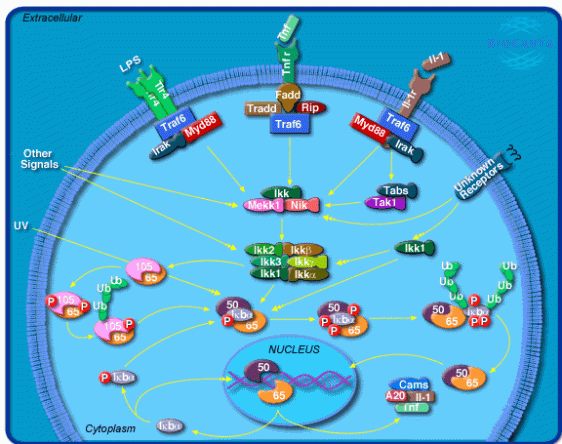
NF-kB Signaling Pathway

Scientists have established the presence of certain proteins in ovarian cancer tissues and have linked these proteins to poor survival rates in women with advanced stages of the disease. The study, led by scientists at the National Cancer Institute (NCI), part of the National Institutes of Health, appears in Cancer online, April 19, 2010.

The proteins in question belong to the nuclear factor kappa Beta (NF-kB) family. NF-kB controls many processes within the cell including cell survival and proliferation, inflammation, immune responses, and cellular responses to stress.

“This study sheds light on the distinctive genetic features of the NF-kB pathway and may provide targets for the development of novel therapies for ovarian cancer,” said lead investigator, Christina M. Annunziata, M.D., Ph.D., associate clinical investigator, Medical Oncology Branch.

Abnormalities in NF-kB signaling have been found in several types of cancer, including ovarian cancer, but the mechanism and importance of such alterations in ovarian cancer was not defined. To address these knowledge gaps, the research team investigated the expression of NF-kB-related proteins in the cells of tumor tissue obtained at surgery from 33 previously untreated women who were newly diagnosed with advanced epithelial ovarian cancer. The patients had similar stage (all late stage), grade, and type of disease. All patients were treated with a three-drug regimen of standard chemotherapy agents in an NCI clinical trial that was conducted at the NIH Clinical Research Center.

To assess NF-kB family members and associated proteins in ovarian tumor cells, the scientists used immunohistochemistry, a method that uses antibodies — a type of protein that the body’s immune system produces when it detects harmful substances — to identify specific molecules in tissue specimens. Subsequently, they looked for associations between the percentage of tumor cells in individual proteins and patient outcomes.

“This study sheds light on the distinctive genetic features of the NF-kB pathway and may provide targets for the development of novel therapies for ovarian cancer,” said lead investigator, Christina M. Annunziata, M.D., Ph.D.

The data revealed that the presence of one NF-kB family member—p50—in more than one-quarter of the cells was associated with poor survival. Low-frequency or nonexpression of a target gene, matrix metallopeptidase 9 (MMP9), was also associated with poor prognosis. Further, the team identified two NF-kB family members—p65 and RelB—and a protein called IKKa that plays a role in promoting inflammation, that were frequently expressed in the same cells, providing more evidence that NF-kB is active in some ovarian cancers. It is possible that the NF-kB activity in these cancers could increase their growth and/or resistance to treatment.

“This work continues to define and characterize the biological relevance of NF-kB activity in ovarian cancer by translating research findings with ovarian cancer cells in the laboratory to ovarian cancer in women at the time of initial diagnosis,” said Annunziata.

About the National Cancer Institute

NCI leads the National Cancer Program and the NIH effort to dramatically reduce the burden of cancer and improve the lives of cancer patients and their families, through research into prevention and cancer biology, the development of new interventions, and the training and mentoring of new researchers. For more information about cancer, please visit the NCI Web site at http://www.cancer.gov or call NCI’s Cancer Information Service at 1-800-4-CANCER (1-800-422-6237).

About the National Institutes of Health

The National Institutes of Health (NIH) — The Nation’s Medical Research Agency — includes 27 Institutes and Centers and is a component of the U.S. Department of Health and Human Services. It is the primary federal agency for conducting and supporting basic, clinical and translational medical research, and it investigates the causes, treatments, and cures for both common and rare diseases. For more information about NIH and its programs, visit www.nih.gov.

Comment

If NF-kB activity is ultimately determined by Dr. Annunciata et. al. to be biologically significant to ovarian cancer cell growth and/or treatment resistance, there are NF-kB inhibitor drugs (e.g., bortezomib (Velcade) or denosumab (Prolia)) in existence that theoretically could be tested in ovarian cancer clinical trials. In addition genistein, a soy isoflavone, and BAY11-7082, a preclinical compound, could be tested through preclinical/clinical testing as potential NF-kB inhibitors.  See Miller SC et. al. study below for a complete list of known NF-kB pathway inhibiting drugs and compounds.

Sources:

European Researchers Find Estrogen Receptor Gene Amplification Occurs Rarely in Ovarian Cancer

“… ESR1 [gene] amplification is an uncommon mechanism for estrogen receptor overexpression in ovarian cancer occurring in about 2.1% of the total number of ovarian cancers. In general, this frequency parallels the fraction of ovarian cancers reported to show complete response to antiestrogenic [anti-hormonal] therapies. Given the strong predictive power of ESR1 [gene] amplification for response to tamoxifen in breast cancer, an evaluation of such treatments in ESR1 [gene] amplified ovarian cancers appears justified.”

Abstract:

“Amplification of the gene encoding estrogen receptor-alpha occurs in about 20% of breast cancers and is an important mechanism for estrogen receptor overexpression in this tumor type. In ovarian cancer, overexpression of estrogen receptor protein has been described in more than two thirds of cases.

To study a potential role of estrogen receptor-alpha gene amplification for estrogen receptor overexpression in ovarian cancer, a tumor tissue microarray containing 428 ovarian cancers was analyzed by fluorescence in situ hybridization [FISH] for estrogen receptor-alpha gene amplification and immunohistochemistry [IHC] for estrogen receptor expression. The estrogen receptor-alpha gene status was successfully determined in 243 of 428 arrayed cancers.

Estrogen receptor gene amplification was found in 5 of 243 (2%) of tumors. Amplification levels were usually low, with 4-8 estrogen receptor-alpha gene copies. However, one case had a high-level amplification, with more than 30 estrogen receptor-alpha gene copies. All five amplified tumors were estrogen receptor positive, with 3 of 5 tumors showing highest (Allred score, 7-8) estrogen receptor levels. The data demonstrate that estrogen receptor-alpha amplification occurs only rarely in ovarian cancer.”

Article Discussion Points:

  • “The results of this study show that ESR1 amplification is rare in ovarian cancers (2.1%). More than one-third of ovarian tumors showed immunohistochemically detectable estrogen receptor protein expression, most abundant in serous and endometroid subtypes. This is in line with previous studies done on the classical paraffin blocks. The good concordance between our data and previous studies demonstrates the representation of our tumor tissue microarray data obtained on a 0.6 mm tissue spot per tumor and enhances the results of other studies used in this method.”
  • “A small subset of ESR1 [gene] amplified estrogen receptor-positive cases was indeed found in ovarian cancers. In comparison, some other genes showed higher rates of amplifications in these cancers. For example, the amplification of ERBB2 ranges (0-66%),  EGFR (3.65-12%),  CCND1 (0-19%), C-MYC up to 54.5,  and KRAS (31%).”
  • “The significant frequency of estrogen receptor positivity in ovarian cancers had prompted treatment efforts using hormonal therapy early on. In addition their relatively little toxicity was another provoking factor to continue going on to achieve more advance in this therapeutic field. Monotherapy studies using tamoxifen, aromatase inhibitors, and GnRH analogues had yielded variable results with objective response rates ranging between 0 and 56%.  Combinatorial treatment regimens combining tamoxifen and goserelin or tamoxifen and Gefitinib had obtained results with objective response rates of up to 11.5%.”
  • “The role of estrogen receptor expression for response prediction to anti-hormonal drugs has been much better studied in breast cancer, where a strong association between estrogen receptor positivity and response to anti-hormonal drugs is well established. … More than 20% of breast cancers had amplified or at least elevated ESR1 [gene] copy number. Possible explanations for the predictive effect of ESR1 [gene] amplification could be a particularly high expression of amplified as compared to non-amplified cancers. Alternatively, it could be speculated, that ESR1 [gene] amplified are more dependent on the estrogen receptor pathway than other tumors that express estrogen receptors together with many other growth receptors. If this latter hypothesis was true, visualization of ESR1 [gene] amplification would pinpoint toward an ‘Achilles tendon‘ of a tumor that could be most successfully targeted.”
  • “The frequency of ESR1 [gene] amplified ovarian cancers (2.1%) is much lower than that in breast cancer. Interestingly, this fraction somehow parallels the percentage of ovarian cancers reported to show strong responses to hormonal therapies.”
  • “For example, in retrospective analysis was conducted of patients who received tamoxifen at a dose 20 mg twice daily for the treatment of advanced epithelial ovarian cancer,
    • Karagol et al found that out of 29 eligible patients included in the study, there were 1 (3%) complete response, 2 (7%) partial response, 6 (21%) stable disease, and 20 (69%) progressive disease.
    • Papadimitriou et al have studied response rate in 27 patients treated with letrozole at a dose of 2.5 mg once a day. Patients with measurable or evaluable disease (n=21) and those with only increasing CA-125 serum levels (n=6) were eligible. Among the 21 patients with measurable or evaluable disease, 1 complete response (5%) and 2 partial responses were observed (10%) for an objective response rate of 15%.
    • Other studies, in which the combined regiment had been implicated, patients were given oral tamoxifen 20 mg twice daily on a continuous basis and subcutaneous goserelin 3.6 mg once a month until disease progression. In total, 26 patients entered this study, of which 17 had platinumresistant disease, using the definition of endocrine response that included patients with stable disease of 6 months or greater, the overall response rate (clinical benefit rate) was 50%. This included one complete response (3.8%), two partial responses (7.7%), and 10 patients with stable disease (38.5%).”
  • “In summary, ESR1 [gene] amplification is an uncommon mechanism for estrogen receptor overexpression in ovarian cancer occurring in about 2.1% of the total number of ovarian cancers. In general, this frequency parallels the fraction of ovarian cancers reported to show complete response to antiestrogenic [anti-hormonal] therapies. Given the strong predictive power of ESR1 [gene] amplification for response to tamoxifen in breast cancer, an evaluation of such treatments in ESR1 [gene] amplified ovarian cancers appears justified.”

Quoted SourceEstrogen receptor gene amplification occurs rarely in ovarian cancer, Issa RM et. al., Mod Pathol. 2009;22(2):191-196, reprinted in From Modern Pathology, Medscape Today, February 18, 2009. [Free Medscape subscription required to view full text article.]

Comment:  This study indicates that the occurrence of estrogen positivity (ER+)/ESR1 gene amplification with respect to ovarian cancer is significantly lower than such occurrence in the breast cancer area.  Nevertheless, it is prudent to request your doctor to have your ovarian cancer tumor tissue tested by a pathologist for estrogen positivity or ESR1 gene amplification (through IHC or FISH testing, respectively).  If your ovarian cancer tissue tests ER+, you may respond to anti-estrogen drugs.  Although this type of pathology testing is commonplace in the breast cancer area, it is not in the ovarian cancer area due to the much lower percentage of ER+ ovarian cancer tumors.  As the study above notes, further research of anti-estrogen therapy use within the area of ovarian cancer is needed, especially given the potential high effectiveness and low toxicity of such therapies.