
BMS-345541 + Dasatinib Resensitizes Carboplatin-Resistant, Recurrent Ovarian Cancer Cells

Johns Hopkins medical researchers discovered through proteomic analysis that RELA and STAT5 are upregulated in carboplatin resistant ovarian cancer cells, according to a published study appearing in the June 18 edition of PLoS One. Moreover, the researchers also demonstrated that BMS-345541 (a NF-kappaB inhibitor) and dasatinib (a STAT5 inhibitor) could resensitize carboplatin-resistant, recurrent ovarian cancer cells.

Although most ovarian cancer patients are initially responsive to platinum-based chemotherapy, almost all develop recurrent chemoresistant tumors. For this reason, Johns Hopkins researchers set out to determine the scientific underpinnings of carboplatin drug resistance in ovarian cancer cells. The researchers compared the proteomes of paired primary and recurrent post-chemotherapy, high grade serous ovarian carcinomas from nine ovarian cancer patients.

As compared to the primary tumors, more than one-half of the recurrent tumors expressed higher levels of several proteins including:  CP, FN1, SYK, CD97, AIF1, WNK1, SERPINA3, APOD, URP2, STAT5B and RELA (NF-kappaB p65).  A short hairpin RNA (shRNA) is a sequence of RNA that makes a tight hairpin turn which can be used to silence gene expression through so-called “RNA interference.” Based on shRNA screening for the upregulated genes in in vitro carboplatin-resistant ovarian cancer cells, the researchers determined that simultaneous silencing of RELA and STAT5B was the most effective way to resensitize tumor cells for carboplatin treatment.

In an attempt to recreate the same results achieved with gene silencing through therapeutic drug use, the researchers used BMS-345541 (a NF-kappaB inhibitor) and dasatinib (Sprycel®)(a STAT5 inhibitor)  to significantly enhance cell sensitivity to carboplatin. The researchers also discovered that expression of RELA and STAT5B enhanced Bcl-xL promoter activity; however, treatment with BMS-345541 and dasatinib decreased such activity.

Accordingly, the researchers concluded that proteomic analysis identified RELA and STAT5 as two major proteins associated with carboplatin resistance in recurrent ovarian cancer tumors. Furthermore, the study results reveal that NF-kappaB and STAT5 inhibitors could resensitize carboplatin-resistant, recurrent ovarian cancer cells, thereby suggesting that these inhibitor drugs can be used to benefit select ovarian cancer patients.

Source: Jinawath N, Vasoontara C, Jinawath A, et. al.  Oncoproteomic analysis reveals co-upregulation of RELA and STAT5 in carboplatin resistant ovarian carcinoma. PLoS One. 2010 Jun 18;5(6):e11198.

Expression of Proteins Linked to Poor Outcome in Women with Ovarian Cancer

Scientists have established the presence of certain proteins in ovarian cancer tissues and have linked these proteins to poor survival rates in women with advanced stages of the disease.

Christina M. Annunziata, M.D., Ph.D., Assistant Clinical Investigator, Medical Oncology Branch & Affiliates, Molecular Signaling Section, National Cancer Institute

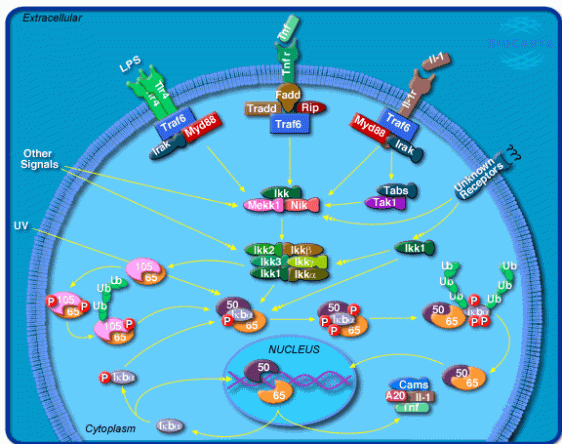
NF-kB Signaling Pathway

Scientists have established the presence of certain proteins in ovarian cancer tissues and have linked these proteins to poor survival rates in women with advanced stages of the disease. The study, led by scientists at the National Cancer Institute (NCI), part of the National Institutes of Health, appears in Cancer online, April 19, 2010.

The proteins in question belong to the nuclear factor kappa Beta (NF-kB) family. NF-kB controls many processes within the cell including cell survival and proliferation, inflammation, immune responses, and cellular responses to stress.

“This study sheds light on the distinctive genetic features of the NF-kB pathway and may provide targets for the development of novel therapies for ovarian cancer,” said lead investigator, Christina M. Annunziata, M.D., Ph.D., associate clinical investigator, Medical Oncology Branch.

Abnormalities in NF-kB signaling have been found in several types of cancer, including ovarian cancer, but the mechanism and importance of such alterations in ovarian cancer was not defined. To address these knowledge gaps, the research team investigated the expression of NF-kB-related proteins in the cells of tumor tissue obtained at surgery from 33 previously untreated women who were newly diagnosed with advanced epithelial ovarian cancer. The patients had similar stage (all late stage), grade, and type of disease. All patients were treated with a three-drug regimen of standard chemotherapy agents in an NCI clinical trial that was conducted at the NIH Clinical Research Center.

To assess NF-kB family members and associated proteins in ovarian tumor cells, the scientists used immunohistochemistry, a method that uses antibodies — a type of protein that the body’s immune system produces when it detects harmful substances — to identify specific molecules in tissue specimens. Subsequently, they looked for associations between the percentage of tumor cells in individual proteins and patient outcomes.

“This study sheds light on the distinctive genetic features of the NF-kB pathway and may provide targets for the development of novel therapies for ovarian cancer,” said lead investigator, Christina M. Annunziata, M.D., Ph.D.

The data revealed that the presence of one NF-kB family member—p50—in more than one-quarter of the cells was associated with poor survival. Low-frequency or nonexpression of a target gene, matrix metallopeptidase 9 (MMP9), was also associated with poor prognosis. Further, the team identified two NF-kB family members—p65 and RelB—and a protein called IKKa that plays a role in promoting inflammation, that were frequently expressed in the same cells, providing more evidence that NF-kB is active in some ovarian cancers. It is possible that the NF-kB activity in these cancers could increase their growth and/or resistance to treatment.

“This work continues to define and characterize the biological relevance of NF-kB activity in ovarian cancer by translating research findings with ovarian cancer cells in the laboratory to ovarian cancer in women at the time of initial diagnosis,” said Annunziata.

About the National Cancer Institute

NCI leads the National Cancer Program and the NIH effort to dramatically reduce the burden of cancer and improve the lives of cancer patients and their families, through research into prevention and cancer biology, the development of new interventions, and the training and mentoring of new researchers. For more information about cancer, please visit the NCI Web site at http://www.cancer.gov or call NCI’s Cancer Information Service at 1-800-4-CANCER (1-800-422-6237).

About the National Institutes of Health

The National Institutes of Health (NIH) — The Nation’s Medical Research Agency — includes 27 Institutes and Centers and is a component of the U.S. Department of Health and Human Services. It is the primary federal agency for conducting and supporting basic, clinical and translational medical research, and it investigates the causes, treatments, and cures for both common and rare diseases. For more information about NIH and its programs, visit www.nih.gov.

Comment

If NF-kB activity is ultimately determined by Dr. Annunciata et. al. to be biologically significant to ovarian cancer cell growth and/or treatment resistance, there are NF-kB inhibitor drugs (e.g., bortezomib (Velcade) or denosumab (Prolia)) in existence that theoretically could be tested in ovarian cancer clinical trials. In addition genistein, a soy isoflavone, and BAY11-7082, a preclinical compound, could be tested through preclinical/clinical testing as potential NF-kB inhibitors.  See Miller SC et. al. study below for a complete list of known NF-kB pathway inhibiting drugs and compounds.

Sources: