
A team of Yale University scientists has synthesized for the first time a chemical compound called “lomaiviticin aglycon, ” which led to the development of a new class of molecules that appear to target and destroy cancer stem cells.
A team of Yale University scientists has synthesized for the first time a chemical compound called “lomaiviticin aglycon,” which led to the development of a new class of molecules that appear to target and destroy cancer stem cells.
Chemists worldwide have been interested in lomaiviticin’s potential anticancer properties since its discovery in 2001. But so far, they have been unable to obtain significant quantities of the compound, which is produced by a rare marine bacterium that cannot be easily coaxed into creating the molecule. For the past decade, different groups around the world have been trying instead to synthesize the natural compound in the lab, but without success.
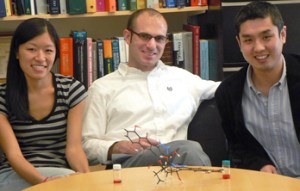
Dr. Seth Herzon (center), along with team members Christina Woo and Liang Lu, synthesized a naturally occurring anticancer compound that scientists worldwide have been trying to replicate in the lab for nearly a decade.
Now a team at Yale, led by chemist Dr. Seth Herzon, has managed to create lomaiviticin aglycon for the first time, opening up new avenues of exploration into novel chemotherapies that could target cancer stem cells, thought to be the precursors to tumors in a number of different cancers including ovarian, brain, lung, prostate and leukemia. Their discovery appears online today in the Journal of the American Chemical Society.
“About three quarters of anticancer agents are derived from natural products, so there’s been lots of work in this area,” Herzon said. “But this compound is structurally very different from other natural products, which made it extremely difficult to synthesize in the lab.”
In addition to lomaiviticin aglycon, Herzon’s team also created smaller, similar molecules that have proven extremely effective in killing ovarian stem cells, said Gil Mor, M.D., Ph.D., a researcher at the Yale School of Medicine who is collaborating with Herzon to test the new class of molecules’ potential as a cancer therapeutic. This family of compounds are called “kinamycins.” The reactive core of the kinamycins also plays a key role in lomaiviticin aglycon, which is even more toxic and could prove even more effective in destroying cancer cells.
The scientists are particularly excited about lomaiviticin aglycon’s potential to kill ovarian cancer stem cells because the disease is notoriously resistant to paclitaxel (Taxol) and carboplatin, two of the most commonly used ovarian cancer chemotherapy drugs. “Ovarian cancer has a high rate of recurrence, and after using chemotherapy to fight the tumor the first time, you’re left with resistant tumor cells that tend to keep coming back,” Mor explained. “If you can kill the stem cells before they have the chance to form a tumor, the patient will have a much better chance of survival — and there aren’t many potential therapies out there that target cancer stem cells right now.”
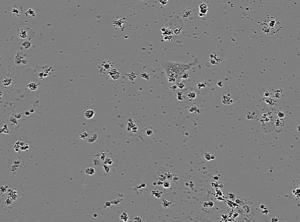
Image of one of the kinamycin compounds synthesized by Yale researchers destroying ovarian cancer cells (the spherical objects) in less than 48 hours in lab tests. (Credit: Gil Mor)
Herzon’s team, which managed to synthesize the molecule in just 11 steps starting from basic chemical building blocks, has been working on the problem since 2008 and spent more than a year on just one step of the process involving the creation of a carbon-carbon bond. It was an achievement that many researchers deemed impossible, but while others tried to work around having to create that bond by using other techniques, the team’s persistence paid off.
“A lot of blood, sweat and tears went into creating that bond,” Herzon said. “After that, the rest of the process was relatively easy.”
Next, the team will continue to analyze the compound to better understand what’s happening to the stem cells at the molecular level. The team hopes to begin testing the compounds in animals shortly.
“This is a great example of the synergy between basic chemistry and the applied sciences,” Herzon said. “Our original goal of synthesizing this natural product has led us into entirely new directions that could have broad impacts in human medicine.”
Other authors of the paper include Liang Lu, Christina M. Woo and Shivajirao L. Gholap, all of Yale University.
Sources:
- Scientists Synthesize Long-Sought-After Anticancer Agent, Press Release (Health & Medicine), Yale University, January 31, 2011.
- Herzon SB, Lu L, Woo CM, et. al. 11-Step Enantioselective Synthesis of (−)-Lomaiviticin Aglycon. Journal of the American Chemical Society, 2011; 110131110847001 DOI: 10.1021/ja200034b
- Yale Scientists Synthesize Unique Family of Anti-Cancer Compounds, Press Release (Science & Engineering), Yale University, February 11, 2010.
- Woo CM, Lu L, Gholap SL, et. al. Development of a Convergent Entry to the Diazofluorene Antitumor Antibiotics: Enantioselective Synthesis of Kinamycin F. Journal of the American Chemical Society, 2010; 100208113952050 DOI: 10.1021/ja910769j
 Libby's H*O*P*E*